Skip to content


Archives for

See all posts in the network tagged with

Extrication Challenges of Advanced Steel

No comments

Firehouse has section on their website and magazine called University of extrication with most articles written by Ron Moore. Ron wrote a 5 part series on the Extrication Challenges of Advanced Steel In Vehicles:

The 5 parts are in pdf format (download the Download Adobe Reader if you do not have it) and print them off. The New Rescue Techniques in Part 5 are a departure from the traditional extrication methods and are definitely outside-of-the-box thinking. Look at the “Pie Cut”, “Lifting the B-Pillar”, “Spreading the B-Pillar”, “Ramming the Roof Off”, and “Total Sunroof ” extrication methods. While these methods were preformed on a car to simulate one with boron and UHSS you should think about trying it to. How many times do we drill or practice extrication the same way over and over. Add one of these methods, maybe all of them to your mental tool box because when you have a MVA with entrapment on a late model vehicle loaded with UHSS is a little too late to think about how!

Advanced Steel Usage in 2008 Chrysler Minivan Body
1 comment
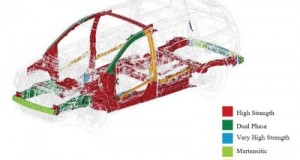
Here is the Advanced Steel Usage in 2008 + Chrysler Minivan Body. This platform includes the Chrysler Town & Country and Dodge Grand Caravan.

BMW X5 B-Pillar UHSS – Where would you make your cut?

No comments
Where would you make your cut? Take a look at the image below before you answer. If you were to make your top cut on the B-Pillar of a late model BMW X5 a couple inches low you would be cutting almost twice the material thickness of the B-Pillar. Start to consider that UHSS also means that material thickness on a part can vary. Tailored steel is what makes this possible.

2010 Porsche Panamera Body Structure (UHSS)

No comments
2010 Porsche Panamera Body Structure. The body shell is knitted together from a number of metals. High strength steels, including Boron-alloyed (shown in red), polyphase (orange), and micro-alloyed (yellow) are used to create an ultra-stiff passenger safety cell. The voluptuous rear fenders are very deep draw stampings, which meant they had to be steel (green). At the front is an aluminum subframe (blue) designed to manage front impact loads. The hood, rear hatch, and fenders are also aluminum, as are the doors, which have ultra-lightweight magnesium frames (turquoise).

Getting more UHSS and Boron Information

No comments

Getting information out of the automakers is sometimes a difficult task. I have friends that work for the Big 3 who usually can dig up some information. A few people I know work at Honda, Nissan, and Toyota. Currently I have them digging up some additonal information on some 2010 and 2011 model years vehicles and the use of Boron and UHSS.

I ran across a get pdf file put together by marketfriendly.com called Growing Use of Molybdenum in Automobiles. The report is about two years old, but gives good insight were the industry was heading at the end of 2007.

Just in case you are wondering what Molybdenum is.

The free element, which is a silvery metal, has the sixth-highest melting point of any element. It readily forms hard, stable carbides, and for this reason it is often used in high-strength steel alloys.

2010 Jeep Compass UHSS

No comments

Jeep has engineered crush zones to divert and dissipate impact energy away from the passenger compartment. The safety cage structure and front crumple zones of the Compass absorb energy during a front impact. During a side impact, the door guard beams help protect occupants. Under the rear seat, a ultra high-strength roll-formed steel cross-beam is bolted to the body structure to help transfer side-impact energy from one side of the car to the other.

The Compass is only stocked full of Airbags, especially side impact Airbags. Make you you locate the inflators for the airbags before any cuts are made to the roof rails. Side impact airbags usually have a string that pulls the airbag downward.

Nissan Zone Body Construction

No comments

Honda has the Advanced Compatibility Engineering (ACE) body structure and Nissan has what they call Zone Body construction. It would make Firefighter’s lives easier if every automaker designed their vehicle around one body structure concept, but that is not the case. However, today we will look at what Nissan does with their Zone Body construction.
Below is a series of crash sequences that show how the Nissan Zone Body Construction responds and acts in a crash.

The body is effectively divided into two zones. A safety zone that protects its passengers via a high strength cabin and crushable zones that safely absorb the impact energy of a crash. Front and rear doors are fitted with guard bars to protect from side impact. Keeping all occupants secure during a frontal and side crash. Crash zone sensors are placed at the closest point to the crush point, behind the front bumper. Improving detection sensitivity in an off-set crash.
Designed to collapse during a frontal collision, it vastly reduces driver impact.

2007+ Jeep Compass

No comments

The higher weight-to-strength ratio of high-strength steel allowed us to develop a body-in-white safety cage that meets more aggressive front-, side- and rear-impact requirements, but without the added weight of regular steel,” Liddane added. “Hot-stamped steel used on the A- and B-pillar and roof-rail reinforcements reduce Compass’ overall weight by 20 kg.” The Jeep Compass uses a tailor-rolled, hot-stamped steel B-pillar. Its two-piece B-pillar construction features a lower section made from mild-strength steel to maximize energy absorption, which is combined with a tailor-rolled, ultra-high-strength upper portion for enhanced occupant protection. For rear-occupant side-impact protection, Jeep Compass also features a hot-stamped steel cross-car beam that is bolted to the body structure underneath the rear seat. During a side-impact event, the beam works together with the integrated foam in the rear doors to transfer impact energy from one side of the vehicle to the other. The beam is designed to take up to 60 percent of the load during a side-impact event. Steel beams within the front and rear doors provide additional side-impact occupant protection.

Hyundai Azera Side Impact Beams and Airbags

1 comment

Here is an image of a 2006 model year Hyundai Azera showing the side impact beams and the side impact airbags deployed. Start noting the side impact airbags and the how much of the window opening the bags fill when deployed.

Press Hardening Steels (PHS)

No comments

PHS Press Hardening Steels are a grade of steel that can be processed at high temperature by heating in a furnace and pressing while still hot using a cooled tool. The rapid cooling rate transforms the microstructure to 100 per cent martensite. PHS steels contain boron for optimum hardenability.

Pocket book of steel

No comments

If you have a little spare time, thumb trough the “Pocket book of steel” from Corus Automotive. Corus Automotive is a UK company that put together the book and claim it to be your complete reference guide to steel in the automotive industry. It is a couple years old, but gives some great examples of steel use with plenty of images.

Scion tC UHSS

1 comment

Parts of the body and structure, including the hood, doors, front rails, and inner door aperture, are made of high-strength steel (HSS). The bumper reinforcements and door intrusion beams on the Scion tC are made of UHSS. The UHSS that is used is a thinner gauge than the mild steel.

We Should Never Forget

No comments

Ford Flex Boron

No comments

The Ford Flex has a body structure that has been optimized with Boron side intrusion beams in the doors and other strategic use of high-strength boron steel and specially designed. The image below shows the side impact door beams. Ford uses Boron Steel on all vehicles side impact door beams.

The body structure of the Flex uses lightweight aluminum-coated boron steel and High-strength steel comprises the Flex’s B-pillars. Ford also states the use ultra-high-strength steel in the A-Pillars.

2009 + Dodge Challenger Boron Beam

No comments
The New Chrysler, or old Chrysler depending on your view on the auto industry has built some really good cars lately. The 2009 + Dodge Challenger has a one-piece bake-hardened steel panel with a hot-stamped boron steel side door guard beam.

Nissan Green Program 2010

No comments

The main reason automakers are using Boron and other Ultra-high Strength Steels is to improve the fuel economy by reducing vehicle weight. The “Nissan Green Program 2010” plans to use High tensile strength steel sheet (HSS) to reduce Body-in-White (BIW) weight. Nissan also plans the use of new 780 & 980 MPa UHSS and its application. Nissan has newly developed Low–Carbon content Dual Phase 780 & 980 MPa steel sheet. Now Nissan is on the way to expanding this UHSS sheet application to BIW globally.

Chevrolet HHR UHSS

No comments

The 2006 + Chevrolet HHR has a little bit of Ultra-high Strength Steel (UHSS) in the the rocker panels. n the image below, number 26 calls out the Rocker Inner Panel and is made from UHSS.

Ford Escape Hybrid High-Volyage Service Disconnect

1 comment

The Ford Escape Hybrid has a High-Voltage Shut-Off Switch that is located in the jack stowage compartment on the passenger side in the cargo area. The purpose of this switch is to disconnect the high-voltage battery in the event of a collision. As a secondary safety precaution you should locate the High-Voltage Service Disconnect Switch and turn it to “Service”. The switch is located on top of the high voltage battery on the passenger side in the cargo area under carpet. The switch is orange in color with a molded plastic handle, about 100 mm (4 inch) in diameter. Provides means to disconnect high-voltage battery for safely servicing vehicle.

  • High-Voltage Service Disconnect Switch Shown in LOCK position.
  • High-voltage system is STILL ACTIVE.
  • Remove switch and place in SERVICE/SHIPPING position to disconnect high-voltage system.

2003-2008 Cadillac SRX UHSS

No comments
The Cadillac SRX model years 2003 through 2008 has a little Ultra-high Strength Steel. The
Rocker Inner Panel (#4) is made using UHSS.

Toyota/Lexus developed Emergency Response Guides (ERG’s)

No comments

Toyota and Lexus developed Emergency Response Guides (ERG’s) for the vehicles that presented new challenges for Firefighters and other First Responders. These guides are deisgned to educate Firefighters and First Responders how to safely handle Toyota and Lexus Alternative Fuel Vehicles. These vehicles include the following technologies CNG Gas, Hydrogen Gas, or High Voltage electrical systems.

The ERG’s cover emergency response procedures in the following specific areas:

  • Vehicle Identification High
  • Hydrogen and CNG gas systems
  • Disabling procedures and warnings
  • Extrication
  • Roadside assistance

Honda Emergency Response Quick Reference

No comments

Honda Motors put together a short Emergency Response Quick Reference Guide. The guide is not completely up to date but very useful for a quick read to throw into your mental toolbox.

Labor Day UHSS Boron Update

No comments

Just wanted to drop a quick note and let everyone know that there will be an update to and Monday.

2009 Honda Element Body Structure

No comments

A few quick images of the Honda Element’s body structure. I’m currently trying to get some information about the steel that is used from Honda. I would image that the yellow represents a high strength steel or reinforcement. Check back for an update on more Honda vehicles.

2010 Chevrolet Camaro Body Structure UHSS

No comments
Even as a Ford guy, I really would hate to see a new 2010 Chevrolet Camaro come under the blades of a cutter! However, we all need to know what to except just in case a 16 year old “borrows” dad’s Camaro for a quick trip and crashes into a tree or rolls one over. As for Ultra-high Strength Steel, the 2010 Camaro is fairly limited. The Rocker Inner Panel (#6 in the image) is the only location that GM calls out UHSS. The Center Pillar Reinforcement (#5) is a High Strength Low Alloy Steel.

Images below are from TopSpeed.com

2008 + GM Chevrolet Malibu UHSS

No comments

General Motors is using UHSS in many different areas of the vehicle. Below is an image of the Body Structure of a Chevrolet Malibu. This use of UHSS is called out on the list below:

  • 10. Center Pillar Reinforcement (Ultra High Strength Dual Phase Steel)
  • 11. Rocker Inner Panel (Ultra High Strength Dual Phase Steel)
  • 12. Door Inner Reinforcement Beam (Ultra High Strength Steel)

Click on 2008 Chevrolet Malibu B-Pillar for detailed information.