Skip to content


Archives for

See all posts in the network tagged with

West Coast Extrication: Part 1, Ron Moore

No comments

My trip started off at the Fremont Fire Department Administrative offices for some classroom training.  The picture of the hydrant below was a gift from the Recruit Class of 01-1 in appreciation for the time, knowledge and training given.   Something I thought was really cool!

I have said this many times on this site.  Ron Moore is one fire service instructor you need to see in person whenever you get the chance.  Ron has a passion for extrication and informing firefighters with useful knowledge to stay up to date with the continuous changes in vehicle technology.  Wednesday was a full day in the classroom where Ron covered airbags, hybrids and electric vehicles, and the advanced steels in vehicle body structures.

Here is a question Ron asked during the airbag portion of class.  What is the maximum number of airbags possible in a vehicle?  What’s your answer? 9, 12, 15, 25 or infinity.  There is no easy answer!  Seatbelt airbags, center mounted seat airbags, door airbags, and the list goes on and on!  Also remember that the “airbag” advertisement on plastic trim and seats is just that, an advertisement.  The location of the airbag and or gas inflator has no direct relation to the advertisement.

The lead instructor, Brock Archer, arranged for a BMW ActiveE electric vehicle to be displayed after lunch for everyone to review and look at.  I have a bunch of the pictures of the BMW ActiveE on the Boron Extrication Facebook Page.  Make sure you check the images out and if you don’t already like our Facebook page, please do!

Stay tuned for parts 2 and 3 of the West Coast Extrication trip!  Part 2 will be on school bus extrication and Part 3 on advanced extrication techniques.

Body Structure: Impact-absorbing body and high-strength cabin

No comments

Toyota used the image below to simply explain how an impact absorbing body and a high strength cabin protects occupants. Just remember, the toughest still will be in the cabin area but can extend into the impact absorbing area too.  Never assume your cutters cannot cut any part of the vehicle, if your cutters stall, go to plan b.  Plan B can be as simple as repositioning the tool.

In order to help reduce the impact on the occupants during a collision and reduce cabin deformation, crumple zones at the front and rear of the vehicle absorb the impact with high efficiency. The cabin uses a body structure that is strong and does not deform easily. To help protect occupants during side collisions, where little crumple zone is available, a high-strength body frame, including the center pillar and the floor cross member, absorbs the impact with decreased deformation.

Detroit bound from a great West Coast Extrication Trip!

No comments

Well the West Coast Extrication trip is over, all that is left to get on the plane and head home back to Detroit.   The bad part is it was almost 80 degrees today in Redwood and it snowed in Detroit last night.  The plan is to break down the trip into a 3 part post. Brock Archer from AdvancedExtrication.com hooked me with a great exposure to West Coast Extrication.  Which is not different from everyone else except they get to train in warm weather in February!

The first will be the classroom portion that Ron Moore from Firehouse Magazine presented.  The second will be the school bus extrication with the scrap yard workers showing how fast they can rip apart a bus.  The final part will be a rundown of the extrication techniques and evolutions covered over the two days of hands on training.

Flying Out West for a Little Extrication Training!

No comments

BoronExtrication.com’s first post flying high over the central United States. Heading out to Fremont California for a train the trainer extrication class that Brock Archer is holding at the Fremont Fire Department Training Center. Brock Archer is the former Assistant Fire Chief for the Hopland Fire District. He is a California State Fire Training instructor and teaches swift water and rope rescue at the NFPA level. Brock is currently teaches auto extrication throughout the U.S. which is why I’m headed west! I missed the first two days of the class but with Ron Moore flying in tonight to teach a full day tomorrow then two solid days of practical extrication training to finish up the class. Every firefighter needs to see Ron Moore at a live presentation. Ron is one the best fire service instructors because he gears his topic to areas that are important and relevant to firefighters operating on an extrication scene.

I also plan to stop by a few firehouses in the San Francisco/ Oakland area. I really would like to meet the firefighters behind Axehead Clothing and Wolfpack Leather Works. Both of those guys are Oakland Firefighters I believe.  

Toyota FJ Cruiser Roof Airbag Gas Inflator
No comments

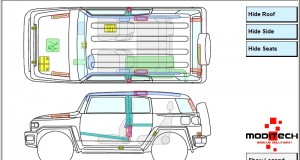
The current Toyota FJ Cruiser (2007-present) has some very large roof airbag gas inflator. Take a look at the images below and let me know what you think. The size of the roof airbag inflators makes me what to reach out to some friends at Toyota and get so information on the volume and PSI on the inflators. Stay tuned!

extrication safety Toyota FJ Cruiser gas inflator airbag

The screenshot below is from Moditech’s Crash Recovery System.  If you haven’t liked Moditech’s Facebook Page you are missing out on some great information that they post on there!  Make sure you like the Boron Extrication Facebook page too!

extrication safety Toyota FJCruiser gas inflator airbag

Toyota FJ Cruiser Roof Airbag Gas Inflator

Toyota FJ Cruiser Roof Airbag Gas Inflator

2012 Hyundai Tucson Body Structure

No comments

The 2012 Hyundai Tucson has a reinforced body structure and six airbags are standard with the side-curtain airbags are equipped with rollover sensors to protect occupants.

The integrated Occupant Classification System even adjusts the force of deployment depending on the size of the front seat passenger. Should the front seat be unoccupied, the passenger airbag won’t activate at all, saving on future repair costs.


The Tucson is equipped with active front head restraints that provide protection against whiplash.  These restraints use body weight to react in a collision.  Just remember that the patient’s movements or the movements we make moving the patient can move the headrest.  Just a little thought to keep in mind, especially with C-Spine precautions.

2012 Hyundai Elantra Body Structure and Airbag

No comments

The 2012 Hyundai Elantra has six airbags, two front, one in each front seat and two side airbags that deploy from the roof.  Also take a look a the side impact door beams, while the beams rarely cause any issues with extrication, knowing where the beams are inside a door and how the door is constructed could help keeping you from skinning the door.

2012 Hyundai Elantra Safety Body Structure Airbag Extrication

2012 Hyunda Safety Side Impact Beams Extrication

Roof Mounted Airbag Gas Inflators?

1 comment

Below is a picture of the gas inflators for the side airbags on a Nissan 350Z.  The inflators are mounted on the roof in the center over the headrest.  Would you look there for a stored gas inflator?

Mercedes Benz GL Class Body Structure

No comments

Below is a unique image of the Reinforced safety cage body structure with over 62% use of High-Strength Low Alloy (HSLA) Steel with ultra high-strength steel in the B-pillars and rocker panels. Make sure you also read below about the airbags, head restraints, and seat belts.

Mercedes Benz GL Class Body Structure

  • 12-WAY AIR BAG PROTECTION, The GL features the 12-way protection of an 8-air bag system. It includes dual-stage front air bags, front and 2nd-row side-impact air bags and full-length window curtain air bags. The window curtain air bags deploy along all three rows of windows on the affected side. When combined with properly worn seat belts, they help to protect outboard occupants from head injury and broken glass in certain side impacts or rollovers.
  • BODY STRUCTURE, The unit body of the GL-Class uses advanced technology and robust materials to create a virtual fortress for its seven passengers. High-Strength/Low-Alloy (HSLA) steel is used in many areas throughout the vehicle and makes up 62% of the body structure. Roof pillars employ three layers of steel, and doors feature steel crossbeams. Full-width front and rear crossmembers, along with a reinforced floorpan and door sills, combine to provide protection in a variety of impacts. Advanced front and rear crumple zones progressively deform to help absorb the energy of an impact, while underhood components are staggered to help prevent them from stacking up in a frontal impact, thereby reducing the likelihood of intrusion into the cabin. An ellipsoidal front bulkhead helps channel some of the forces of a frontal impact under, over and around the passenger cabin.
  • ACTIVE HEAD RESTRAINTS, In the case of a rear impact exceeding a preset threshold, the Active Head Restraints spring forward, reducing the distance between the head restraint and the front-seat occupants’ heads. This action helps limit the rearward travel of their heads, thus reducing the possibility of whiplash-like neck injuries.
  • SEAT BELTS, Seat belts are arguably the most important passive safety feature, so the GL incorporates seat belts with Emergency Tensioning Devices (ETDs) and adaptive belt force limiters at all outboard seating positions. In the event of a collision exceeding a preset threshold, the ETDs use a pyrotechnic charge to instantly remove slack from the seat belts. Adaptive belt force limiters allow a slight amount of give in the seat belts. This helps to more evenly distribute the forces between the seat belts and air bag (for front-seat occupants) and reduce the peak seat-belt forces on the occupant.


2012 Chevrolet Truck and SUV Body Structures

No comments

Below are side views of the 2012 Chevrolet Truck and SUV body structures. The images show great details on the pillars, rocker panels, and roof rails. The inner fender structures and reinforcements are also displayed.

2012 Chevrolet Equinox

2012 Chevrolet Traverse

2012 Chevrolet Tahoe

2012 Chevrolet Colorado

2012 Chevrolet Avalanche

2012 Chevrolet Silverado

2012 Chevrolet Express Passenger Van

Seagrave TDA Stephen Siller Foundation Diecast

No comments

Seagrave TDA Stephen Siller Foundation

The folks over at TWH have made a diecast worth adding to your collect.  With Code 3 Collectibles throwing in the towel there is a spot for someone to step up the game for fire apparatus diecast models.  The website http://www.diecastmodels.co/seagrave-tda-stephen-siller-foundation/ has the Seagrave and Pierce Fire TWH diecast models.  Make sure you sign up for an account to save 10% of your order.  Also, if you buy a TDA or the new Pierce Velocity 75′ Ladder they throw in fire Pierce Engine!  Make sure you tell them you found their website at Boron Extrication.

I have several of the TWH models and they blow away Code 3 Collectibles!  The TWH diecast fire apparatuses are so detailed and built with precision, they make other diecast models like a matchbox car.

Stephen Siller was one of the 343 firefighters who lost their lives on Sept. 11, 2001.  While on his way to play golf with his brothers, he got the call that the Twin Towers were under attack.  Siller immediately donned nearly 70 pounds of gear and ran through the Brooklyn Battery Tunnel to the World Trade Center to help his fellow Americans.

Siller and 342 other firefighters died that day. And this incredibly detailed die-cast firetruck pays tribute to them all. Both the Stephen Siller Tunnel to Towers Foundation and FDNY logos are featured prominently on each side of the truck.

And the Sept. 11 design will serve as a constant reminder to never forget to honor the bravest among us.

A portion of the proceeds from the sale of each firetruck directly benefits the Stephen Siller Tunnel to Towers Foundation.  Submit your order now.

SCALE: 1:50 TYPE: Diecast / multi-material FUNCTIONS:

  • Steerable front tractor axle
  • Steerable trailer axle
  • Pivoting opening cab that reveals detailed engine
  • Functional axle suspension
  • Extendable 4 section diecast ladder with extending waterway
  • Below grade ladder extension feature
  • Functional outriggers
  • Removable outrigger pads
  • Continuous 360 degree ladder rotation
  • 180 degree tractor arc

FEATURES:

  • Detailed tiller cab design
  • Accurate hose and wire detail
  • Accurate front bumper design
  • Exterior air intake detail
  • Accurately designed rims
  • Work and safety lighting
  • Roof mounted air handling unit
  • Air compressor and air hose routing detail
  • Photoetch steps
  • Diamond plate decking
  • Accurate ladder accessories
  • Accurate storage compartment design
  • Detailed Marauder II cab design that features the following: – SCBA tanks and SCBA seating – Headsets – Fans – Literature on console – Radio equipment – Console with detailed gauges

MODEL DIMENSIONS:

  • Length of tractor and trailer: 14.5″ (368mm)
  • Length of tractor: 6″ (152mm)
  • Length of trailer: 10.25″ (260mm)
  • Width of tractor and trailer: 2″ (51mm)
  • Height: 2.625″ (67mm) ladder in stored position
  • Height: 24.75″ (629mm) ladder extended/maximum angle
  • Length of ladder: 8.25″ (210mm) stored position
  • Length of ladder: 23″ (584mm) extended
  • Weight: 1.75 lbs. (0.79kg)

BOX DIMENSIONS:

  • Length: 14.25″ (362mm)
  • Width: 6.75″ (172mm)
  • Height: 5.625″ (142mm)

QTY PER MASTER CARTON: TRUCK NUMBERS AVAILABLE / PRODUCTION QTY: 500 DEPARTMENT: Fantasy

National Alternative Fuels Training Consortium Training App

No comments

John Shafer over at the GreenMaltese.com posted about the National Alternative Fuels Training Consortium (NAFTC) offers first responder safety training.  This training equips first responders with the knowledge they need to confront a growing number of automotive accidents involving AFVs.

The National Alternative Fuels Training Consortium’s First Responder Safety Training features a suite of modern technology products and training for electric drive vehicles. Participants learn important information needed to safely respond to accidents involving these vehicles. These topics include key vehicle and fuel properties and characteristics, vehicle components, vehicle identification and recommended first responder procedures. The suite of products includes:

  • Instructor manuals
  • Participant manuals
  • Workshop booklets
  • Quick reference guide
  • Mobile device app
  • Online training (for Electric Drive only)>/li>

 This first responder quick reference guide, developed by the National Alternative Fuels Training Consortium (NAFTC), is a tool for emergency personnel who need to access information about alternative fuel and advanced technology vehicles at an accident scene. This app contains information on advanced technology vehicles such as hybrid, plug-in hybrid, battery, and fuel cell electric vehicles, as well as vehicles powered by alternative fuels such as biodiesel, ethanol, natural gas, propane, and hydrogen. You will find detailed, vehicle-specific information including identification mechanisms, disconnect procedures, and other special concerns. Although similar, each vehicle has distinct differences that make it unique, and first responders need to know and understand these differences. The NAFTC understands the hazards that alternative fuel and advanced technology vehicles could pose to emergency personnel, and this app, along with our entire suite of First Responder Safety Training products, provides first responders with the information needed to safely respond to an accident involving one of these vehicles. This app can be used on both the iPhone and the iPad.