Skip to content


Archives for

See all posts in the network tagged with

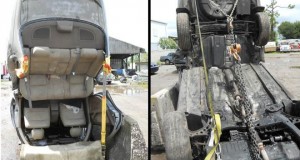
What do you know about Chains and Hooks?
7 comments

What Grade of Chain for Rescue Use?

Answering the question of which grade of chain to use for rescue appilcations is not so cut and dry.  Chains come in various strengths depending on intended usage.  Grade 70 chains for example are typically used in towing applications.  Grade 80 or better are the only chains rated for overhead lifting.  Some say that since Grade 70 chains are used by tow operators to pull and load vehicles onto a flatbed tow truck than rescuers can use them.  Others say that you need a chain that is rated for overhead lifting.  Firehouse Expo HOT instructor Billy Leach, recommends that only Grade 80 or better should be used for extrication.  My department has Grade 70 chains on the heavy rescue.  What does your department use?  A more important question is what chain should you use?

“Working load limit” “Proof test” and “Minimum break load”

  • Weight Load Limit (WLL) is the maximum working load designed by the manufacturer.
  • Proof Test is where a load is applied to the newly produced chain as a quality control measure. The proof test is not a performance measure, it is only intended to draw the manufacturer’s attention to any flaws in the chain. The common load applied is twice the WLL, or half the expected break load.
  • Minimum Break Load (MBL) is the minimum force which chain or components must withstand before failure.
  • Safety Factor (SF) is the structural capacity of a chain beyond the expected loads or actual loads.  The safety factor is a ratio of maximum strength to intended load for the actual item that was designed.  The design load being the maximum load the part should ever see in service.Commonly shown in a ratio like 4:1.

The Meaning of Chain Grade Numbers

The chain grade numbers which manufacturers use are actually one tenth of the actual grades. Therefore, our grade 80 is 800, grade 70 is 700, and so on.

The grade refers to the tensile strength of the chain. This is expressed in newtons per square millimeter (a newton is approximately 0.224805 lbs). The tensile strength is calculated by multiplying the grade times the area of the two cross sections of a link.

(Area) 157.08 mm2 x 800 n (Grade)=125,664 newtons ultimate breaking strength
125,664 newtons x .224805=28,250 lbs ultimate breaking strength
125,664 newtons÷1000=125.66 kn (Kilonewtons)

Is there a strength difference between Grade 70 and 80?   Compare a  3/8” Grade 70 that has a working load of 6,600 Lbs with a 4:1 safety factor with a 3/8” Grade 80 that has a working load of 7,100 Lbs with a 4:1 safety factor.   The higher grade 80 chain only gives you a 7% gain in strength going from Grade 70 to 80.

So which chain should you use?  I referenced a post from Firehouse.com University of Extrication forum named Overhead Lifting and Chain Grade posted by Tim O’Connell. Tim just happens to be the Owner/President of Rescue 42.

Grade 70 chain is made from heat treated Carbon steel which produces a more closed surface porosity as well as removing the high susceptibility to Hydrogen embrittlement. Grade 70 chains are galvanized, Zinc Chromated or treated with some other corrosion resisting sacrificial anode material. They survive the salt spray test for many days (instead of hours for 80/100). They are MUCH tougher than the 80/100 chains. They resist battery acid extremely well due to their sacrificial anode coating as well as their resistance to Hydrogen embrittlement.

Grade 70 chain is the correct choice for extrication. Grade 70 chain is called “Transport” chain. It is made of heat treated Carbon steel. It is still incredibly strong, and the lack of the special alloys both produces a more closed surface porosity as well as removing the high susceptibility to Hydrogen embrittlement. Grade 70 chains are galvanized, Zinc Chromated or treated with some other corrosion resisting sacrificial anode material. They survive the salt spray test for many days (instead of hours for 80/100). They are MUCH tougher than the 80/100 chains. They resist battery acid extremely well due to their sacrificial anode coating as well as their resistance to Hydrogen embrittlement.

Make sure you read the complete post that Tim wrote on FireHouse.com.  He contacted several engineers at the two largest chain manufacturers in the US and got their professional opinions.

Hooks and Clusters

Mini J Hook

Mini J-Hook

Grab Hook

Grab Hook

T-Hook Extrication Chain

T-Hook

Mini R-Hook

Mini R-Hook

Large_J-Hook_Extrication-Chain

Large J-Hook

Mini J-Hook, T-Hook & Grab Hook

Cluster: Mini J-Hook, T-Hook & Grab Hook

Billy Leach has provided a bunch of information on chains and hooks from his HOT classes at Firehouse Expo last week.  Make sure you print out, read, and share all of his Hands-On Training Heavy Rescue For Heavy Vehicles pdf handouts below:

Safety

Check Wear Regularly

Firehouse Expo 2012 Extrication Speaker handouts

No comments

The handouts for a good number of the Fire house Expo 2012 were posted online for everyone to benefit from.  Check out Ron Moore and Billy Leach’s handouts!

Hopefully,  I’ll get a chance to present at Firehouse Expo 2013.  I have a few great ideas for classes!

Hands-On Training: Heavy Rescue For Heavy Vehicles (HT4 OR HW4):

The Challenges of Extrication Involving Vehicles With Advanced Steel:

Heavy Truck Anatomy and Extrication:

Hybrid & Electric Plug-In Vehicle Fire & Rescue Procedures:

Train the Trainer Vehicle Extrication Denver – Ron Moore & Brock Archer

No comments

Brock Archer is one of the few guys out there with a vehicle extrication train the trainer course.  His course has been fined tuned and is a 4 day Train the Trainer that fully prepares participants to teach the latest in Vehicle Extrication.  This course is hosted by the Denver Fire Department and Ron Moore is also teaching a full day in the classroom and a full hands on day bringing the knowledge he continues to grow because of his work with the NFPA, American Iron and Steel Institute, and automakers globally.  Sign up quick, before all the spots are gone!

More course information

Train the Trainer Vehicle Extrication Denver – Ron Moore & Brock Archer

Opel Zafira Tourer Body Structure

No comments

A quick look at the steel cage and airbag protection system on the Opel Zafira Tourer.

Opel Zafira Tourer Body Structure

Opel_Zafira_Tourer_Body_Structure

Opel_Zafira_Tourer_Body_Structure


2013 Hyundai Equus Airbags

No comments

2013 Hyundai Equus Knee airbag extrication

The 2013 Hyundai Equus has 9 airbags. Two advanced dual front airbags; a driver’s knee airbag; four front and rear seat-mounted side-impact airbags; and two roof-mounted side-curtain airbags for front- and rear-seat passengers.

2013 Hyundai Equus Body Structure BIW

2013 Hyundai Equus seat airbag extrication

Bergen Toll Plaza Hybrid Car Fire

1 comment

Looking at the pictures, what is the first thing that comes to your mind? I hope one quick thought will make a light go one!

New Jersey highway officials say two cars were involved in an accident at a Garden State Parkway toll plaza that resulted in a car hitting a toll booth and bursting into flames.  State Police Sgt. Brian Polite says a Toyota Prius driven by 86-year-old Ralph Schiller of Fort Lee was approaching the Bergen Toll Plaza in Saddle Brook around 3:30 p.m., when it side-swiped a Honda Accord driven by Kristie Frost of Pasadena, Md. Police say Schiller’s car continued forward and struck a barrier and a toll booth, and the booth and car both caught fire.

Below are a few key instructions from the Toyota Prius Hybrid Emergency Response Guide:

Offensive Fire Attack

Normally, flooding an NiMH HV battery pack with copious amounts of water at a safe distance will effectively control the HV battery pack fire by cooling the adjacent NiMH battery modules to a point below their ignition temperature. The remaining modules on fire, if not extinguished by the water, will burn themselves out. However, flooding the PRIUS c HV battery pack is not recommended due to the battery case design and location preventing the responder from properly applying water through the available vent openings safely. Therefore, it is recommended that the incident commander allow the PRIUS c HV battery pack to burn itself out.

Defensive Fire Attack

If the decision has been made to fight the fire using a defensive attack, the fire attack crew should pull back a safe distance and allow the NiMH battery modules to burn them selves out. During this defensive operation, fire crews may utilize a water stream or fog pattern to protect exposures or to control the path of smoke.

When allowed to burn themselves out, the PRIUS c NiMH battery modules burn rapidly and can quickly be reduced to ashes except for the metal.

Nearly every Emergency Response Guide that the automakers published is available for download on our Emergency Response Guides/ page.

2013 Infiniti JX35 Body Structure

No comments

Here is a quick look at the 2013 Infiniti JX35 body structure.

2013 Infiniti JX35 Body Structure Extrication

2013 Infiniti JX35 Body Structure Extrication

2013 Infiniti JX35 Body Structure Extrication

2013 Infiniti JX35 Body Structure Extrication

2013 bi-fuel Chevrolet Silverado HD

1 comment
Type 3 CNG tank

Type 3 CNG Tank

The 2013 bi-fuel Chevrolet Silverado HD includes a compressed natural gas (CNG) capable engine that seamlessly transitions between CNG and gas fuel systems. Combined, the truck offers a range of more than 650 miles. The trucks use a 17-gallon Type 3 CNG tank made from composite material with aluminum liner and carbon fiber wrap. GM placed a collar around the head of the tank for further safety.

GM mounts the tank through the bed of the truck to the frame; the fuel door is high up and out of the impact area. All of the high pressure fuel lines run inside of the frame rails.

2013 Bi-Fuel Chevrolet Silverado HD

2013 Bi-Fuel Chevrolet Silverado HD

2013 Bi-Fuel Chevrolet Silverado HD

2013 Bi-Fuel Chevrolet Silverado HD

Extrication Knowledge at Home Depot?

2 comments

Extrication Knowledge at Home Depot? Yup!  It’s free too!  Take a look at the GMC truck below, it’s a propane model that looks to have many miles on it.  I was writing a quick note after I snapped these pictures to leave under the wiper and the guy jumped in and drove off.  But here’s a great look at propane tanks mounted in the frame.

Make sure you like the BoronExtrication Facebook page!

GMC Propane Tank Extrication

GMC Propane Tank Extrication Box Truck

GMC Propane Tank Extrication Box Truck

Extrication Knowledge at Home Depot?

GMC Propane Tank Extrication Box Truck

GMC Propane Tank Extrication Filler

GMC Propane Tank Extrication Box Truck

The last thing I was expecting to see in the parking lot only a row over was a Opel Vauxhall Ampera electric vehicle which is the brother to the Chevy Volt in Europe.  Notice it’s a right hand drive?  Check out a previous post on the Opel Vauxhal Ampera.

Opel_Vauxhall_ Ampera_Electric_Vehicle_Volt_HV

Opel_Vauxhall_ Ampera_Electric_Vehicle_Volt_HV

Opel_Vauxhall_ Ampera_Electric_Vehicle_Volt_HV

2012 Electric Car Sales Forecast

No comments

So just how many plug-in electric cars are expected to be sold in the U.S. in 2012?  (This doesn’t include hybrid vehicle) Last year in the U.S., just under 18,000 electric plug-in cars were sold.  Halfway through 2012, here are the projections for the whole year:

Chevrolet: 20,000
Nissan: 15,000
Toyota: 14,600
Ford: 3,000
Tesla: 5,000
BMW: 700
Mitsubishi: 1,000
Coda: 1,000
Honda: 1,100
Fisker: 1,000
TOTAL: 62,400

That would easily more than triple the 2011 sales level, but still constitute just under half of 1% of the total U.S. car market in 2012.  It would take 140,000 electric plug-in vehicles to make 1% 0f the 2012 U.S. car market.  Check out the article on TheStreet.com;  2012 Electric Car Sales Forecast that breaks down the different models per automaker.  You can also look at Top 10 Electric Car Makers on CleanFleetReport.com.

If you include hybrid and plug-in hybrid vehicles the number of vehicles sold increase!

2012 Electric Vehicles Plug In PEV

Leave it up to the automakers to have new names for the different types of Hybrid and electric vehicles.

  • Electric vehicles (EVs)
  • Battery Electric Vehicles (BEVs)
  • Plug-in electric vehicles (PEVs)
  • Hybrid electric vehicle (HEV)
  • Plug-in hybrid electric vehicles (PHEVs)

Keep in mind that the hybrid and electric vehicle market closely follows gas prices.  When gas prices fall, so do the sales of hybrid and electric vehicles. This demonstrates that while there is consumer interest in hybrid and electric vehicles, demand is heavily influenced by the economic environment, rather than pure interest in the technology.   Hybrid and electric vehicle sales are expected to account for 3.2 percent of total light-vehicle in 2012.

2012 Jeep Wrangler Body Structure

No comments

Just because the Jeep Wrangler has a removable soft-top and/or hardtop doesn’t mean this vehicle is cut and dry sample for an extrication.  Well, there is nothing out of the ordinary.  The Jeep Wrangler is a body-on-frame construction and the sport bar (roll-bar) uses high-strength steel and is integrated into the B-Pillar that runs into the floor.  Very minimal airbags with standard front multistage and optional seat airbags.

Keep in mind that Jeep Wranglers owners like to customize and change their vehicles.  Don’t be surprised if you encounter additional batteries to supply power to items like off-road lights.   You never know what changes have been made!  Remember your situational awareness and expect the unexpected!

2012 Jeep Wrangler Body Structure Extrication

2012 Jeep Wrangler Body Structure Extrication

Below is a screenshot from Moditech‘s Crash Recovery System (CRS).

Jeep Moditech CRS Extrication

Variable Torque Motors (VTM) Hybrid System

No comments

Did you ever think you would encounter the Flux Capacitor from the movie Back to the Future at an MVA?  Do you need to look out for 1.21 gigawatts?  Believe it or not, the Flux Capacitor was an ultra-capacitor.  Though the Variable Torque Motors (VTM) ultracapacitors aren’t made to hold the massive 1.21 gigawatts of the DeLorean in the movie.

The VTM Hybrid is designed for all types of Class 3 though 7 vehicles including shuttle buses, refuse trucks, delivery vans and school buses. The VTM Hybrid is the most affordable hybrid solution on the market. How the system works is it automatically adds torque ahead of the engine to boost acceleration and then conserving energy normally lost in the braking process. What is very interesting is the system is 500 pounds lighter than alternative hybrid systems because instead of batteries it uses ultracapacitors to store energy. Yes good old ultracapacitors!

Ultracapacitors Hybrid Extrication VTM

Ultra-Capacitor_hybrid_Extrication_ultracapacitor

Variable Torque Motors ERG

Emergency shutoff switches are clearly marked and easily located (including one at the driver’s side) in case of an accident or for maintenance safety.  These switches isolate the ultra-capacitors to ensure that no power can be discharged to the vehicle and simultaneously inform emergency responders that the vehicle is a hybrid, which can change their response tactics.

Variable Torque Motors