Skip to content


2013 Ford Fusion Body Structure (Hydroformed)

No comments

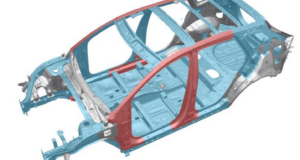
The 2013 Ford Fusion uses hydroformed steel tubes for its B-pillars and a hydroformed A-pillar roof rail.  So why is this important to us?  Using hydroforming instead of hot-stamped welded sheet to create the car’s roof-pillar structure reduced mass, saved cost, reduced the bill of material (which is the number of parts welded together to make the B-pillar), and helped improve the new Fusion’s crash performance. The hydroformed steel tubes replaced hot-stamped parts. B-pillars are a common place to find hot-stamped boron and the hydroformed steel tubes are replacing it in the 2013 Fusion.

2013 Ford Fusion Body Structure (Hydro-formed)

2013 Ford Fusion B-Pillar Body Structure UHSS

Take a close look at the two images below of the body structure of the previous design and the new hydroformed design.  Notice that the previous design used boron steel and the new hydroformed design does not.  I’m going to try to work some magic and see if I can get my hands on a 2013 Fusion but since it is new it might take a little time before showing up in scrap yards.

2013 Ford Fusion Body Structure A-Pillar Boron Extrication

2013 Ford Fusion Body Structure B-Pillar Boron Extrication


B-pillar ‘tailor rolled’ to 8 different thicknesses

No comments

The 2013 Ford Focus is packed full of boron and other ultra-high strength steels.  But, let’s take a look at the B-pillar and the material it is made from.  The B-pillar is made from tailored rolled steel blanks that allow parts to have different thicknesses through one part.  The important nugget to take away from this is if a cutter ever stalls during a cut, simply moving the tool up or down an inch or two can allow the cut to be successful.

2013 Ford Focus B-Pillar Body Structure

Colors indicate eight different thicknesses in the B-pillar post of the forthcoming Ford Focus. The right-hand color strip starts with the thinnest sections at the bottom (four shades of blue), rising to two shades of green and then one each of yellow and orange (thickest at 2.7 mm). The eight thicknesses on the Focus B-pillar range from a maximum of 2.7 mm (0.1 in) to as thin as 1.35 mm (0.05 in). The engineering of the shape puts the greatest thicknesses where they are needed for maximum strength in side impacts, and in the case of the B-pillar it’s just above the midpoint (orange area in illustration).

Check out the body structure of the 2012 Ford Focus which is carried over into the 2013 model.

2012 Jeep Patriot Body Structure

No comments

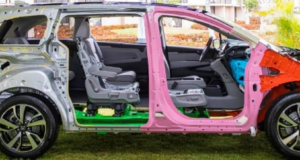
Check out the body structure and safety features in the 2012 Jeep Patriot.

2012 Jeep Patriot Body Structure
  • Advanced multistage front airbags that adjust airbag output to crash severity
  • Supplemental side-curtain front and rear airbags+ offer side protection for all of the outboard occupants
  • Available supplemental front seat-mounted side airbags
  • Engineered crush zones divert and dissipate impact energy away from the passenger compartment
  • Safety cage structure and front crumple zones absorb energy during a front impact
  • Door guard beams help protect occupants during side impact
  • Ultra high-strength roll-formed steel crossbeam helps transfer side-impact energy from one side of the car to the other

2012 Jeep Patriot Body Structure

Audi A5 Body Structure

No comments

Here’s a quick look at all the different steels in the Audi A5.

Audi A5 Body Structure Extrication

Audi A5 Sportback body structure BIW

2013 Mazda CX5 Body Structure

No comments

The 2013 Mazda CX-5 received the IIHS’ best marks of “good” in front, side, and rear-impact tests, and rollover tests.  The new body architecture was developed as part of Mazda’s breakthrough SKYACTIV TECHNOLOGY program, and incorporates a new energy absorbing structure as well as an expanded use of high tensile steel to reduce weight.  The new chassis incorporates 61% high-tensile strength steel, and in the bumpers and other key areas incorporates ultra-high tensile strength steel.  Standard safety equipment in all CX-5 models includes: six airbags, anti-lock disk brakes, daytime running lights, dynamic stability control and traction control, seat belt pre-tensioners, and a fold-away brake pedal assembly.


2013 Chevrolet Malibu Eco; AKA a Hybrid, kind of!

4 comments

The Chevrolet Malibu Eco vehicles are front-wheel drive, five passenger vehicles with a lightly electrified gasoline engine. The eAssist system utilizes a high voltage battery, located in the trunk, as a supplemental power source. The system assists the engine utilizing a high torque belt-driven starter / generator.

2013 Malibu Eco Chevrolet eAssisst Extrication Hybrid Battery HV Cable

The eAssist system features a 130 volt lithium-ion battery, which provides electrical energy to the starter / generator. The high voltage battery assembly is located in the trunk behind the rear passenger seats. The assembly includes several internal components that operate together to provide and control the high voltage for the eAssist system.

 2013 Malibu Eco Chevrolet eAssisst Extrication Hybrid Battery HV Cable

There are two separate electrical systems within the eAssist vehicles: low voltage (12 V) and high voltage (130 V). The low voltage system is similar to a conventional vehicle.

Do NOT cut the:

  • Roof rails near the center pillar; contains side curtain airbag inflators
  • Front seat back on the outboard edge; contains side airbags
  • Center pillar near the rocker; contains the seat belt retractor pretensioner and side impact sensor

2013 Malibu Eco Chevrolet eAssisst Extrication Hybrid Battery HV Cable Body Structure

The Chevrolet Malibu Eco is designed to protect the occupants during a collision. The body structure contains high strength steel; this is highlighted in blue. The occupants are protected from front, rear, and side impacts by a structural cage created by the underlying vehicle structural design.  Additional crumple zones protect the occupant with front, side, and rear rails that are designed to crush in a crash.

2013 Malibu Eco Chevrolet eAssisst Extrication Hybrid Battery HV Cable Body Structure

Cut through the low voltage cables on each side of the yellow labels to remove a section of the cable to ensure the cables cannot inadvertently reconnect.

Make sure you read thru the Emergency Response Guides below:

Crash Recovery System for Android in April!

No comments

The very fine folks at Moditech annouced in their latest newsltter that the Crash Recovery System for Android will be availible in April!  The availability of the Crash Recovery System for different hardware platforms is a declared objective of Moditech Rescue Solutions B.V. This allows our users maximum flexibility in selection of the necessary hardware. Among the CRS editions for different versions of the Microsoft Windows operating system and the Apps for the Apple iPhone and Apple iPad the Crash Recovery System family will soon become two additional members.

Currently, two apps for devices with the operating system Android are in the works. CRS Lite for Android will be specifically designed for users of Android smartphones and will have similar functions as the CRS Lite Edition and iCRS Lite for iPhone. For users of Android Tablet PCs the App CRS Standard for Android is under development, covering similar functions as the CRS and iCRS Standard Editions, joining the vehicle graphics with extensive illustrated background and deactivation information.

Weber Rescue Tips and Tricks: Ram the Roof

No comments

Here a quick step by step from Weber Rescue on how to complete a Fahrzeugsäulen reiben.  What’s a  Fahrzeugsäulen reiben?  Translated from German to Vehicle column rub.  Also known as a Ram the Roof!

Weber Rescue Extrication Tips Tricks B-pillar Ram Roof

Steps:

  1. Stabilize the vehicle.  Make sure there is adequate cribbing to support the ram on the rocker panels.
  2. Remove the doors
  3. Clear the rocker panel to bare metal
  4. Position the ram with the base on the rocker panel and the piston end on the roof rail rearward of the b-pillar
  5. Extend the ram to tear the b-pillar from the roof rail.  If the b-pillar does not completely separate, reposition the ram in front of the b-pillar and extend the ram to separate the rest of the b-pillar.

2013 Lexus GS Body Structure

No comments

The 2013 Lexus GS Body Structure has an exterior weight reduction through a combination of aluminum alloys, high-tensile strength steel, ultra high-tensile strength steel and hot-press steel.  Yes the steel that has to be heated before it’s stamped!

Hot-pressed steel is used for the upper B-pillar and the roof side-rails.

2013 Lexus GS Body Structure

2013_Lexus_GS_350_UHSS_Steel

2013 Lexus GS Body Structure Extrication

2013 Lexus GS Body Structure Extrication

2012 Holden Commodore Body Structure (Au)

1 comment

Here is a quick post for our readers from Australia, The Holden Commodore body structure.  The B-pillar (yellow) is Ultra High Strength Steel for cab protection in side impacts.


2012 Mercedes-Benz M-class Body Structure

No comments

The 2012 Mercedes-Benz M-Class is a rigid uni-body structure that encircles the passenger cabin in a highly protective network of ultra-high and high-strength steel, magnesium reinforcements and triple-layer construction of all eight roof pillars.  Advanced crumple zones and subframe-mounting of the axles help to  divert impact forces away from the passenger compartment.


2012 Chevrolet Sonic Body Structure

No comments

The body structure of the all-new 2012 Chevrolet Sonic sedan and hatchback. Nearly 60 percent of the body structure, as well as the four-mount hydro-formed engine cradle, use high-strength steel. Ultra-high-strength steel is strategically integrated in the forward portion of the rockers and the center cross bar.

© Copyright General Motors

The reinforced front hinge and A- and B-pillar zones help maintain the integrity of the passenger compartment.  The roof is capable of supporting up to four times the car’s weight.

© Copyright General Motors

© Copyright General Motors

© Copyright General Motors

The all-new 2012 Chevrolet Sonic is the only vehicle in its class with 10 standard airbags. . The Sonic features dual-stage airbags for the driver and the front passenger and roof-rail mounted head curtain airbags and seat mounted side-impact airbags for front and outboard rear seat passengers as standard. A driver knee air bag and a segment-exclusive front passenger knee air bag are included to reduce injury to lower extremities.

© Copyright General Motors

© Copyright General Motors

On the hatchback, the door handles are concealed in the C-Pillar and are rendered in black, as is the trim, giving the car the appearance of a two-door hatchback.

2012 Mazda 3 Body Structure (Stronger B-Pillar)

2 comments

The 2012 Mazda 3 does not look different from the 2011, but don’t let that feel you that there were no changes to the body structure. For 2012 models, the B-pillar reinforcement has been extended by more than seven inches and more high tensile steel was added to further increase body rigidity. This change is in all Mazda3s, regardless of trim level or engine choice.  Keep in mind that all Mazda3s will continue to feature Mazda’s own highly rigid safety body structure, which incorporates: 

  • Crushable outer zones that absorb impact energy
  • Mazda’s Triple H construction, which applies H-shaped reinforcements to the floor, side frames and roof to suppress cabin deformation.
  • For 2012 models, the B-pillar reinforcement has been extended by more than seven inches and more high tensile steel was added to further increase body rigidity. 

A few other notable standard advanced safety features include: 

  • Six airbags (advanced dual front, front-seat mounted and full-length side curtain) with improved double chamber side airbags
  • A “crushable” brake and accelerator pedal assembly and collapsible steering column
  • Front seat-belt pretensioners with force limiters


2011 SEAT León Body Structure

No comments

The body structure of the 2011 Seat León is unitised made from galvanised steel and uses 50% more high-strength and ultra-high-strength steels than in the previous León, 63% of the steels used are high-strength and 5% are ultra-high-strength.  The sheet-metal components that make up the top section of the body (which are the roof, side panelling, pillars and side skirts) as well as the protective bars in the doors are mostly high-strength steels.  The frame structure in the lower section of the new León is also composed of a high percentage of high-strength steels.

One manufacturing process that I have cover on this site before is hot stamping or hot pressing.  The B-pillar is built from ultra-high-strength steels which are also manufactured using a hot-pressing process.  This technology deviates from conventional pressing and replaces it with a combination of techniques, including heating the sheet-metal blank prior to forming it in the press.  After the blank is formed a refrigeration system built into the stamping press cools the part which is trimmed to its’ final shape by laser-cutting.

Laser welding is another process that was covered a while back.  The tremendous static rigidity of the new León has been achieved by assembling the body using 5,100 mm of laser welding and 5,000 mm of structural bonding. Assembly furthermore involves applying 3,700 resistance-welding spots as well as 3,200 mm of arc welding.

2011 Cadillac SRX Body Structure Identification

No comments

The 2011 Cadillac SRX Body Structure has a wide range of different Ultra-High Strength Steel (UHSS) to consider during an extrication.  Just remember that so many different factors come into play when cutting UHSS so never think that you are outgunned!  Have a Plan A, Plan B, etc!

2011 Cadillac SRX Body Structure Identification Extrication

The B-Pillar (item 10) is a combined mixture of different UHSS.  The outer B-Pillar is martensitic and the inner reinforcements are Dual Phase Steel and other UHSS.  The Side Door Impact Beams (item 13) and Rocker Panel (item 14) are made with UHSS.

service B-Pillar

Cadillac Service B-Pillar

The collision repair guide on the 2010-2011 Cadillac SRX states that the B-Pillar can only be replaced as a one piece, no sectioning!  The service B-Pillar will come as a complete assembly and the center B-Pillar Reinforcement is constructed of ultra high strength steel (martensitic).   Ultra High Strength Steel normally has a tensile strength greater than 700 MPa.

Here’s a little interesting note I ran across from GM, when GM calls out UHSS this classification includes common steel names of Martensitic Steel (MS), Press hardened Steel (PHS), and Boron Steel.

2011 Cadillac SRX UHSS B-Pillar Inner Body Structure Extrication

Inner Reinforcements of the B-Pillar

The Inner reinforcements of the B-Pillar are seen in the image to the right with the rocker panel and outer B-Pillar removed.  Remember the reinforcements are UHSS Dual Phase.  General Motors states that Ultra High Strength Dual Phase Steel (Dual Phase Steel with a tensile strength greater than 800 MPa), also known as DPX cannot be repaired.

2007-2010 Subaru Impreza WRX STi Body Structure

2 comments

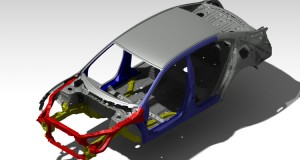
Just remember, most Subarus are going to made of a ton of Boron and other UHSS.  The Subaru Impreza WRX STi is no different.  Just take a look at all the red colored pieces of the body structure below. 

Porsche Cayenne Construction body UHSS and Boron

No comments

The Cayenne body is a study in advanced high-strength steels. The body is primarily high-strength steel, though the outer quarter panel and rear floor pan are mild steel and the hood and door window frames are aluminum. UHSS is used on the tubular reinforcement in the rocker panels, upper A-pillar reinforcements, inner B-pillar reinforcements, door intrusion beams, a floor pan crossmember between the B-pillars, and the floor pan tunnel. The UHSS inner B-pillar reinforcements and the upper A-pillar reinforcements are transformation induced plasticity (TRIP) 700 steel. The complete lower rails and rocker panel reinforcement tubes are dual-phase (DP) 600 steel. Tailored blanks are used on the outer front and rear rails, roof rails, and the door shells to vary the strength of the steels within the same part. Porsche uses boron-alloyed steel on several vehicles, especially on the door intrusion beams, though there is none on the Cayenne.

2008 Chevrolet Malibu B-Pillar

2 comments

If you take a look at the image below you will see that the B-Pillar reinforcement is made from Dual Phase (DP) 980. Just in case you are wondering where DP 980 ranks in the strength of UHSS take a look at the chart on the Types of Steel (UHSS) post from August.

2010 Ford Fusion Side Impact Protection

No comments

With the Ford Fusion one of the best selling cars in the US. Here are a few things to think about the Fusion’s side-protection elements.

  • Two energy absorbing foam blocks between the inner door panels and interior trim, aligned with the occupants’ chest and hip.
  • Side-intrusion beams inside the door, anchored at the hinge and latch areas.
  • Tailor-welded steel in the B-pillar structure with extra thickness–nearly a quarter inch of solid steel–above the beltline.
  • Seat-deployed thorax air bags for front occupants and side-curtain air bags for head protection in both rows.

Notice the extra thickness of the B-pillar? A quarter inch of solid steel above the beltline. Ford states that from below the beltline upward you will run into the additional steel. Store that nugget away in your mental toolbox.

Your cut needs to be below the red line. The picture is the shoulder belt from the front passenger perspective. The picture belows displays the outside location of the beltline.

2009 Audi A4 UHSS

No comments

The A4 is not an aluminum car. But what’s somewhat striking is that even the top U.S. Audi executive, de Nysschen, notes the fact that there is an extensive use of ultra-high-strength steel (UHSS UHSS Ultra-High-Strength Steel ). This is not the sort of thing that is typically glossed by someone with their eye on business and sales, not structural engineering. Yet the use of the material is absolutely notable, and contributes to a rigid body structure, as well as enhancing safety.

There is the use of hot-formed boron boron alloyed steel blanks to produce various components. In the hot forming operation, the blanks are heated to 1,742[degrees]F, formed, and quenched. To put out (a fire, for example); extinguish. The resulting tensile strength of the component is as much as 1,600 mPa. Among the ultra-high-strength steel applications are the center tunnel, inner sills, B-pillars and firewall transverse beams. Overall, about 12% of the body-in-white is made of hot-formed UHSS; 18% is UHSS; 32% is high-strength steel; and 38% is conventional deep-drawing steel grades.

Extrication Challenges of Advanced Steel

No comments

Firehouse has section on their website and magazine called University of extrication with most articles written by Ron Moore. Ron wrote a 5 part series on the Extrication Challenges of Advanced Steel In Vehicles:

The 5 parts are in pdf format (download the Download Adobe Reader if you do not have it) and print them off. The New Rescue Techniques in Part 5 are a departure from the traditional extrication methods and are definitely outside-of-the-box thinking. Look at the “Pie Cut”, “Lifting the B-Pillar”, “Spreading the B-Pillar”, “Ramming the Roof Off”, and “Total Sunroof ” extrication methods. While these methods were preformed on a car to simulate one with boron and UHSS you should think about trying it to. How many times do we drill or practice extrication the same way over and over. Add one of these methods, maybe all of them to your mental tool box because when you have a MVA with entrapment on a late model vehicle loaded with UHSS is a little too late to think about how!

BMW X5 B-Pillar UHSS – Where would you make your cut?

No comments
Where would you make your cut? Take a look at the image below before you answer. If you were to make your top cut on the B-Pillar of a late model BMW X5 a couple inches low you would be cutting almost twice the material thickness of the B-Pillar. Start to consider that UHSS also means that material thickness on a part can vary. Tailored steel is what makes this possible.

Pocket book of steel

No comments

If you have a little spare time, thumb trough the “Pocket book of steel” from Corus Automotive. Corus Automotive is a UK company that put together the book and claim it to be your complete reference guide to steel in the automotive industry. It is a couple years old, but gives some great examples of steel use with plenty of images.

2008 + GM Chevrolet Malibu UHSS

No comments

General Motors is using UHSS in many different areas of the vehicle. Below is an image of the Body Structure of a Chevrolet Malibu. This use of UHSS is called out on the list below:

  • 10. Center Pillar Reinforcement (Ultra High Strength Dual Phase Steel)
  • 11. Rocker Inner Panel (Ultra High Strength Dual Phase Steel)
  • 12. Door Inner Reinforcement Beam (Ultra High Strength Steel)

Click on 2008 Chevrolet Malibu B-Pillar for detailed information.

2007 and Later Dodge Caliber

No comments

The 2007 and later Dodge Caliber has Ultra-High Strength Steel UHSS in the A-pillar, B-pillar, and roof-rail reinforcements. The B-pillar is made from a tailor-rolled, hot stamped steel which would tell you that the pillar will have different thicknesses. The two-piece pillar includes a lower section made from mild strength steel, and is combined with a tailor-rolled ultra high-strength steel upper section.

Just in case you were wondering what a Tailored-rolled steel is, here is the answer. A flat piece of metal that is stamped into a part is called a blank. A Tailored blank combines different thicknesses and grades of steel into a single blank.