Archives for uhss
The 2014 Chevrolet Silverado will start hitting the streets. The new model is packed full of new design features that have change the body structure. Nothing too out of the ordinary, but some areas to take a look at.
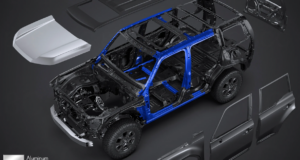
To ensure that the new Silverado is up to the challenge, key elements of the updated frame, including the main rails and major cross members, are made from high-strength steel. Hydroforming is used to improve strength and reduce mass of the front of the frame.
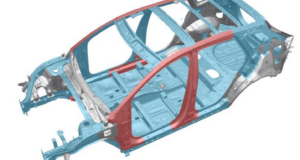
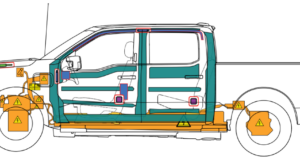
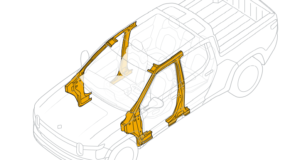
The cab structures are all new, and incorporate high strength steel in the A-pillars, B-pillars, roof rails and rocker panels. Ultra-high-strength steel is used in areas of the rocker panels and underbody in anticipation of new shallow-offset crash tests. In all, about two-thirds of the cab structure is made from high-strength steels.
The front structure is made from aluminium die castings, extrusions and pressings. The passenger compartment is made from steel, including roll-formed boron steel in critical load path areas. The roof panel and all of the closures are aluminium.
The body consists of 50% light alloy in combination with high- and ultra-high strength steels. We have achieved maximum crash safety and outstanding body rigidity for the best noise and vibration comfort.”

Take a quick look at the 2013 Porsche Cayenne Body Structure. Notice what appears to be a box where the driver’s seat would be installed? That is the battery box for the 12V battery. Just like the VW Touareg. The screenshot from Moditech’s Crash Recovery System (CRS) clearly shows the 12V battery underneath the driver seat.
Here is one for the folks over in the United Kingdom. Just like every Volvo on the road today, the 2013 V40 Cross Country has a body structure packed full of different materials. What I found interesting is Volvo lists “Very High Strength Steel”, ” Extra High Strength Steel”and ”Ultra High Strength Steel” in the structure. What that means is Volvo is optimizing the use of the different strengths of steels. Ultra High Strength Steel (UHSS) is very expensive to manufacture into stampings so using a weaker steel in different areas to complement the UHSS while reducing costs.
The Jaguar XK Body Structure is unique because of the extensive use of aluminium. The Jaguar XK body shell is made out of aluminium with the use of aluminium castings and extruded parts along with aluminium stamped panels.
Below is a screenshot from Moditech’s Crash Recovery System that shows the all the information available Notice that the A-Pillar shows a UHSS reinforcement. This shouldn’t come as a surprise, especially since this vehicle is available in a coupe and a convertible.
Below the reinforcement is shown in the cutaway vehicle:
The automatic transmission in the Jaguar XK has a knob and electric parking brake.
The 2013 Ford S-MAX has a body structure made up of Ultra-High Strength Steel (UHSS) with safety features that include a collapsible steering column and retracting pedals that collapse away from the driver. The S-MAX has driver’s and front passenger’s airbags; front side impact airbags; front and second row side-curtain airbags (deployed from the headlining); and driver’s knee airbag. Ford S-MAX being awarded a maximum 5-star Adult Occupant Rating in Euro NCAP crash tests.
The 2013 Ford Focus is packed full of boron and other ultra-high strength steels. But, let’s take a look at the B-pillar and the material it is made from. The B-pillar is made from tailored rolled steel blanks that allow parts to have different thicknesses through one part. The important nugget to take away from this is if a cutter ever stalls during a cut, simply moving the tool up or down an inch or two can allow the cut to be successful.
Colors indicate eight different thicknesses in the B-pillar post of the forthcoming Ford Focus. The right-hand color strip starts with the thinnest sections at the bottom (four shades of blue), rising to two shades of green and then one each of yellow and orange (thickest at 2.7 mm). The eight thicknesses on the Focus B-pillar range from a maximum of 2.7 mm (0.1 in) to as thin as 1.35 mm (0.05 in). The engineering of the shape puts the greatest thicknesses where they are needed for maximum strength in side impacts, and in the case of the B-pillar it’s just above the midpoint (orange area in illustration).
Check out the body structure of the 2012 Ford Focus which is carried over into the 2013 model.
The 2012 (actually since 2009) Mercedes Benz S-Class is made from a bunch of Ultra High Strength Steel. The B-Pillar and rockers are made from Mega High Strength Steel. Make sure you take a look at the screen shot below from Moditech’s Crash recovery System (CRS) and compare it to the other images. Crash Recovery System would have provided some useful information on scene of a MVA that involved a S-Class.
Check out the body structure and safety features in the 2012 Jeep Patriot.
- Advanced multistage front airbags that adjust airbag output to crash severity
- Supplemental side-curtain front and rear airbags+ offer side protection for all of the outboard occupants
- Available supplemental front seat-mounted side airbags
- Engineered crush zones divert and dissipate impact energy away from the passenger compartment
- Safety cage structure and front crumple zones absorb energy during a front impact
- Door guard beams help protect occupants during side impact
- Ultra high-strength roll-formed steel crossbeam helps transfer side-impact energy from one side of the car to the other
There is really nothing too crazy with the body structure of the 2013 Toyota Corolla. There is some Ultra-High Strength Steel in the A-Pillar (A-Post) and in the doors. Based on the picture below if you are making a relief cut or just cutting the A-Pillar for a roof removal if your older cutters stall out. Just move your tool high up the A-Pillar to get post the reinforcement. Always remember to pull away the interior trim pieces to check for stored gas inflators.
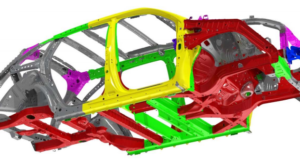
Here’s a quick look at all the different steels in the Audi A5.
Audi A5 Sportback body structure BIW
The all-new architecture incorporates a new design that not only improves distortion rigidity by 16 percent, it also incorporates a 30-percent increase in the use of ultra high-strength-tensile steel to improve collision energy management. High-strength steel also allows the suspension to work optimally and reduces weight. Ultra-high strength tensile sheet metal has also been applied to the outer door panels for the first time in the company’s history. In addition, anti-corrosion steel was applied to 70 percent of outer frame and floor structure.

New hot stamping and roll forming methods have also been applied to impact members, which provide added strength, reduces the number of body parts and makes the architecture lighter. The amount of structural adhesives has also been increased significantly for improved body rigidity, crashworthiness and durability.
Nissan Motor Co., Ltd. announced in late 2011 the world’s first* Ultra High Tensile Strength Steel rated at 1.2 gigapascals (GPa) which is highly formable, to the extent that it can be used for cold pressing structural body parts. To be deployed globally in models across the Nissan lineup from 2013, it will reduce vehicle body weight by up to 15 kilograms, representing a significant step in improving environmental impact as well as driving performance.
Developed in collaboration with Nippon Steel Corporation and Kobe Steel, Ltd., the new Ultra High Tensile Strength Steel will be used for center pillar reinforcements, front and side roof rails and other key structural components. By exceeding the structural body performance of previous materials with less thickness, the new steel will contribute to increased dynamic performance and fuel economy.
The new material will also contribute to lower total costs including that of manufacturing, as superior cold-pressing formability supports mass production.
This new breakthrough overcomes significant obstacles. Until now, high tensile strength steel involved a critical trade-off: increased strength came with increased rigidity and a consequent reduction in press formability. Traditionally, only high tensile steel rated up to 980 megapascals (MPa) can be used in cold pressing structural body parts, requiring complex press work.
The new 1.2 GPa steel, combined with Nissan-developed advances in welding methodology, overcomes both obstacles.
Development of the new material was realized by a breakthrough in the ability to control its structural formation at the sub-micron level in combining hard and soft layers to achieve both strength and formability.
Once the new material was developed, extensive experimentation was required to develop an optimal spot-welding methodology. This has been achieved with a proprietary process that involves careful optimization of welding pressure, current volume and power distribution.
By adopting the new material to various parts of the vehicle, Nissan’s new 1.2GPa Ultra High Tensile Strength Steel with High Formability will contribute significantly to overall vehicle weight savings without adding the extra cost required by other lightweight materials, such as aluminum.
The Chevrolet Malibu Eco vehicles are front-wheel drive, five passenger vehicles with a lightly electrified gasoline engine. The eAssist system utilizes a high voltage battery, located in the trunk, as a supplemental power source. The system assists the engine utilizing a high torque belt-driven starter / generator.
The eAssist system features a 130 volt lithium-ion battery, which provides electrical energy to the starter / generator. The high voltage battery assembly is located in the trunk behind the rear passenger seats. The assembly includes several internal components that operate together to provide and control the high voltage for the eAssist system.
There are two separate electrical systems within the eAssist vehicles: low voltage (12 V) and high voltage (130 V). The low voltage system is similar to a conventional vehicle.
Do NOT cut the:
- Roof rails near the center pillar; contains side curtain airbag inflators
- Front seat back on the outboard edge; contains side airbags
- Center pillar near the rocker; contains the seat belt retractor pretensioner and side impact sensor
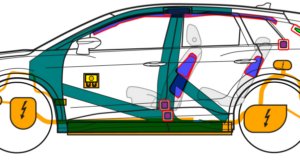
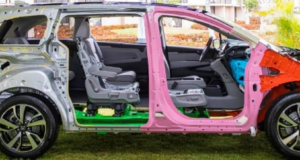
The Chevrolet Malibu Eco is designed to protect the occupants during a collision. The body structure contains high strength steel; this is highlighted in blue. The occupants are protected from front, rear, and side impacts by a structural cage created by the underlying vehicle structural design. Additional crumple zones protect the occupant with front, side, and rear rails that are designed to crush in a crash.
Cut through the low voltage cables on each side of the yellow labels to remove a section of the cable to ensure the cables cannot inadvertently reconnect.
Make sure you read thru the Emergency Response Guides below:
Toyota used the image below to simply explain how an impact absorbing body and a high strength cabin protects occupants. Just remember, the toughest still will be in the cabin area but can extend into the impact absorbing area too. Never assume your cutters cannot cut any part of the vehicle, if your cutters stall, go to plan b. Plan B can be as simple as repositioning the tool.
In order to help reduce the impact on the occupants during a collision and reduce cabin deformation, crumple zones at the front and rear of the vehicle absorb the impact with high efficiency. The cabin uses a body structure that is strong and does not deform easily. To help protect occupants during side collisions, where little crumple zone is available, a high-strength body frame, including the center pillar and the floor cross member, absorbs the impact with decreased deformation.
The 2013 Lexus GS Body Structure has an exterior weight reduction through a combination of aluminum alloys, high-tensile strength steel, ultra high-tensile strength steel and hot-press steel. Yes the steel that has to be heated before it’s stamped!
Hot-pressed steel is used for the upper B-pillar and the roof side-rails.
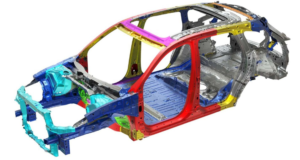
The European Chevrolet Aveo is sold in North America as the Chevrolet Sonic. Sixty percent of the 2012 Chevrolet Aveo Body Structure is made from high-strength steel (HSS colored in yellow). This includes the engine cradle. Ultra-high Strength Steel (UHSS colored in red) is strategically integrated in the forward portion of the rockers and the center cross bar. The engine cradle distributes energy in frontal and side impacts. It is another structural element that helps optimize occupant safety. Together with the front bumper system and the engine compartment rails, the engine cradle bars absorb the brunt of a frontal crash.
Reinforced A and B-pillar help maintain the integrity of the passenger compartment. Should the vehicle roll over in the event of an accident, its roof will be able to withstand forces that equal more than four times the car’s weight. The Chevrolet Aveo also has a releasable pedal assembly.