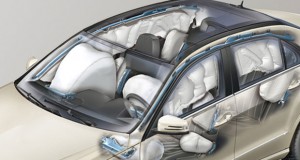
Archives for airbag
Here’s a quick look at the 2013 Lexus LX body structure and airbags.
10-airbag system, including: Driver’s and front passenger’s advanced airbag system with front passenger’s twin-chamber airbag, Driver’s and front passenger’s knee airbags, Front and rear Roll-Sensing Curtain Airbags (RSCA), Front seat-mounted side airbags, and Rear seat-mounted side airbags.
Below are a couple of pictures of the rear seat belt pretensioners. These pretensioners are located in the base of the C-Pillar.
It is no secret that the Ford Fiesta has a bunch of UHSS and born steels in the body structure. We reviewed the 2011 Ford Fiesta when it was first released to the US market. Below are a bunch of pictures of the 2013 Ford Fiesta from the auto show that highlights are the strong steel used.
Make sure you follow the BoronExtrication Facebook and hit “Like”
The body structure of the 2013 Porsche Cayman is now predominantly aluminium, with the rest fashioned from a combination of magnesium and hot formed high-strength steel.
The Cayman is equipped as standard with full-size and knee airbags, which are inflated in two stages depending on the severity and type of accident (e. g. frontal or offset frontal). In less serious accidents, the airbags are only partially inflated, thereby minimizing discomfort to the occupants. So that should to tell you right away that these are dual-stage airbags.
Just like every Subaru, the 2013 Impreza has their Ring-Shaped Frame Reinforcement body structure with extensive use of high-tensile steel in body structure for strength and safety. All 2013 Impreza models feature a driver’s knee airbag on a roster of safety features that also includes standard front side pelvis/torso airbags and side curtain airbags that offer front and rear outboard seat coverage. The passenger-seat front airbag features a shell-type design with a center groove, thus exposing the passenger to less impact force upon deployment. The seatbelts have pretensioners and force limiters.
Here’s a question for you, do know what “acoustic side windows” really means? If your a regular reader of the blog, you should quickly translate acoustic front windscreen and optional acoustic side windows made with multilayer glass technology to provide great noise insulation to laminated side glass. The image of the 2013 Mercedes-Benz GL below id from the Rescue card for passenger cars. Where’s the battery? How many batteries do you see? See both of them? labeled 1 and 2. Also take note of the suggested cut points. Mercedes-Benz provides extrication cut points that are away from airbag inflators and often are a place on the vehicle where the body structure is weaker.

Guidelines for rescue services are available in various languages as downloadable PDF files. Mercedes-Benz updates the guides below so the information in it is current to assist rescuers during an extrication. Here’s a great company drill or something to read through with your crew.
The 2013 Ford S-MAX has a body structure made up of Ultra-High Strength Steel (UHSS) with safety features that include a collapsible steering column and retracting pedals that collapse away from the driver. The S-MAX has driver’s and front passenger’s airbags; front side impact airbags; front and second row side-curtain airbags (deployed from the headlining); and driver’s knee airbag. Ford S-MAX being awarded a maximum 5-star Adult Occupant Rating in Euro NCAP crash tests.
The automotive industry has changed the way first responders approach a motor vehicle accident compared to a decade ago. Air bags are standard equipment, pretensioners are used in second and third row seats, and the seats are starting to resemble a firefighter jet seat with the technology packed into a small package. Situational Awareness is the new catch phrase in the extrication world. First responders must be aware of hazards of a vehicle from bumper to bumper!
For years extrication trainers preached peel away the plastic interior trim to ensure an air bag gas inflator is not in the cut path. However, those days are long gone! What we need to start doing is a quick “trauma assessment” if you will on our vehicles before we make a cut to any pillar or roof structure. Once the interior trim is pulled off palpate any visible nylon air bag curtains close to the metal. Deployed gas inflators statistically do not pose a safety hazard if cut. However, the best stance to take is to never cut through a gas inflator because there is no method available to us to determine if the inflator is still charged.
Occupant sensors in the front seats are devices that measure the distance away from the steering wheel or dash and weigh the occupant to determine if the air bag should be deployed in a crash. Have you ever put your backpack on the passenger seat and notice that the “Air bag Off” light turns on? This is an example of the sensor weighing the load on the seat and determining that the occupant in the seat does not meet the minimum weight for the air bag to deploy in a crash.
Pretensioners
Seatbelt pretensioners tighten the belt a few inches to prevent the occupant from jerking forward in a crash. Pretensioners are mounted in two different methods, to the seat belt retractor located in a body pillar or on the seat structure. Front seat mounted pretensioners are typically mounted to the top of the seat adjustment track. Seat mounted pretensioners will moved the seatbelt buckle and not the seatbelt. A center console usually provides enough protection for first responders not to have to worry about any hazards from charged pretensioners.
Buckle mounted pretensioners uses gas stored in the tube to retract the buckle during certain crashes. Retractor mounted pretensioners like the TRW one in is set off by any electronically fired pyrotechnic charge which retracts the seatbelt by 80mm, which is more than three inches. During the earlier stages of a crash, the pretensioner removes excess slack in the seatbelt to begin effective occupant restraint.
Pretensioners are not reserved for front seat passengers. Many late vehicles like the Volvo have pretensioners in the rear seats. Pyrotechnic pretensioners in the rear seats can be buckle or retractor mounted. Many rear seats that are split into 60/40 seats have a metal tower that is thick and big that holds a high mounted seat belt retractor. This tower is located in the 60% seat or the larger of the two. If the seats are split up into 40/20/40 than the tower is located in the center or 20% seat.
Some vehicles have a pre-collision safety system that includes an electric motor-pyrotechnic pretensioner system. During a pre-collision event like extreme sudden hard braking, an electric motor in the pretensioners retracts the front seatbelts. Once the event stabilizes the electric motor will reverse itself. The pyrotechnic pretensioners function normally and separately from a motor-pyrotechnic pretensioner system.
Load limiting is a safety that is used to minimize belt-inflicted injuries. A basic load limiting feature is sewn into the belt webbing and stitches are designed to break when a certain load is applied to the belt. The belt extends when the stitches come apart and allow the sewn webbing to unfold. A mechanical load limiting device use
Air bags
Air bags entered the automotive market as an air bag in the driver’s steering wheel. In 2011 model year vehicles, 10 different air bags in per vehicle are no longer a feature reserved for expense luxury vehicles. Automakers proudly advertise air bags on the vehicle interior on the steering wheel, bash panel, and pillar trim panels.
Seat Air bags
Seat mounted air bags are not a new hazard facing first responders. The difference is in the size and numbers of air bags packaged in a
seat are changing. Front seats can have two separate air bags to protect the occupant during a crash. This number is expected to increase when centered mounted seat air bags are used. Seat air bag are located along the outside of seat back frame and the bag is stored in a deflector called a “Taco” that directs the air bag when deployed.
Center Mounted Seat Air bag
General Motors has developed a front center air bag deploys from the right side of the driver’s seat and positions itself between the front row seats near the center of the vehicle. The tubular tethered air bag is designed to act as an energy absorbing cushion between driver and front passenger in side crashes. The air bag will also be deployed during a rollover. The center mounted seat air bag will be in the Buick Enclave, GMC Acadia, and Chevrolet Traverse starting in the 2013 model year. Toyota developed a rear center console with an air bag that deploys between the rear passenger seats. Toyota has not put this air bag into production yet, but it is likely to make into a vehicle platform soon.
Side Air bags
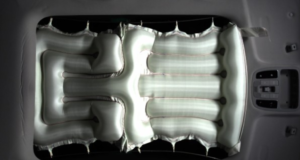
Occupant ejection mitigation is new safety requirement that the automakers must meet by 2017. Side air bags and glazing of side window glass are the methods being tested and engineered into current model vehicles. These air bags will be large volume that can run from A-pillar to D-pillar. The 2011 Grand Caravan has a side impact air bag over nine feet long and is inflated by a stored gas inflator the size of a child’s lunchbox thermos and has over 10,000psi!

2011 Dodge Caravan Side Air bag
Knee Air bags
Knee air bags are typically located underneath the steering wheel on the angled portion of the instrument panel. The knee air bag module is a rectangle box easily package as a complete air bag systems with the gas inflator inside. This helps during installation at the auto plants and allows this system to be used in different vehicles.
Door Air bags
Many luxury auto makers have started installing door air bags. The air bags are typically installed in the center of the door.
Airbelts
The 2011 Ford Explorer was the first production vehicle to have inflatable rear seat belts. Ford plans to offer inflatable seat belt technology in vehicles globally in the future. What is important to remember is the airbelt requires a stored gas inflator store in the seat. A pioneering company, Moditech, provides current information on hazards inside and outside the vehicle. Moditech developed the Crash Recovery System (CRS) and the image below of the 2011 Ford Explorer.
Key Fobs
Keyless ignition is nothing new but many automakers are offering the features on their vehicles. Hyundai offers keyless ignition with a key fob or smart key that works on proximity. So how do you turn the car off if there is no key in the ignition? Most vehicles have a “Start” or “Power” button that is used to switch the ignition from off, to on, or to ACC. Make sure you the button indicator light is off. If you see a “READY-ON” light on the display the vehicle is started. This is very important with hybrid or electric vehicles because of the quiet operation. An important note, on some vehicles the “Power” button indicator light turns off when the vehicle is started. That is why it is important to make sure you do not see “READY-ON”!
Batteries
First responders are aware of hybrid and plug-in electric batteries inside of the passenger compartment. However, 12-volt batteries can also be found inside of the passenger compartment. For example, the GMC Acadia has the 12-volt battery located in the floor behind the front passenger seat.
Is that vehicle totaled?
Late model vehicles have dozens of safety systems that keep occupants safe during a crash or rollover. Just because the vehicle may look repairable does not necessarily mean it is. Plastic interior trim panels and seat covers are designed to rip or tear when air bags deploys. Seat structures are engineered to distribute the load of an occupant. Seatbelts can have rip stitching to absorb energy from the occupant. Pyrotechnic pretensioners are onetime use. Keep in mind that most of the time in a serious accident the glass is already broken out and the windshield typically has spider marks from the air bags or occupants. Never let the fear of “totaling” a vehicle compromise patient care. Just remember all the hazards mentioned in this article are real and in vehicles.
The 2012 Dodge Challenger is available in three models and rides on a shortened version of the Dodge Charger and Chrysler 300 platform. One important note is the the Challenger is from four-door architecture on the L-platform which was shortened to a two-door. Keep in mind that the C-Pillar of this vehicle is very large and has the roof curtain airbag inflators located in the C-Pillar as seen in the screenshot below from Moditech’s Crash Recovery System (CRS).
Is safety at the scrap yard and at extrication training a priority? Here is one reason to drill and drive home to peel away the trim and look for airbag inflators even on old cars in the scrap yard. Yesterday a 2001 Volvo S40 was included in the vehicles at the local scrap yard for the man behind FirtDueTackle.com and me. When I looked inside the driver door the was a small door in the trim at the top of the B-Pillar. The door had a marking cooling out a roof airbag. I pulled out Moditech’s Crash Recovery System and looked up the vehicle and sure enough there is a roof airbag with the inflator located in the middle of the C-Pillar. It was easy to assume that that a 11 year old vehicle wouldn’t have inflators in the pillars, but that is a dangerous assumption.
Check out the body structure and safety features in the 2012 Jeep Patriot.
- Advanced multistage front airbags that adjust airbag output to crash severity
- Supplemental side-curtain front and rear airbags+ offer side protection for all of the outboard occupants
- Available supplemental front seat-mounted side airbags
- Engineered crush zones divert and dissipate impact energy away from the passenger compartment
- Safety cage structure and front crumple zones absorb energy during a front impact
- Door guard beams help protect occupants during side impact
- Ultra high-strength roll-formed steel crossbeam helps transfer side-impact energy from one side of the car to the other
Just because the Jeep Wrangler has a removable soft-top and/or hardtop doesn’t mean this vehicle is cut and dry sample for an extrication. Well, there is nothing out of the ordinary. The Jeep Wrangler is a body-on-frame construction and the sport bar (roll-bar) uses high-strength steel and is integrated into the B-Pillar that runs into the floor. Very minimal airbags with standard front multistage and optional seat airbags.
Keep in mind that Jeep Wranglers owners like to customize and change their vehicles. Don’t be surprised if you encounter additional batteries to supply power to items like off-road lights. You never know what changes have been made! Remember your situational awareness and expect the unexpected!
Below is a screenshot from Moditech‘s Crash Recovery System (CRS).
The world’s first pedestrian airbag fitted as standard on the all-new Volvo V40 is the next step towards the manufacturers target that no-one should be killed or injured in a new Volvo by 2020.
For complete A to Z on how the pedestrian airbag works, check out the Technology update May 2012 | PEDESTRIAN PROTECTION AIRBAG from our friends over at Moditech.
Moditech’s extrication expert Jörg Heck provides a quick reminder for us. “Switching the ignition to the off position and, if possible, isolating the vehicles electrical system are very important measures to keep in mind. In addition, rescuers should always maintain a safety distance from an undeployed pedestrian protection airbag, while working on the crashed vehicle with heavy equipment. Therefore it’s essential to know what’s inside!” Remember as more safety features are added rescuers need to keep learning and adding to their mental toolbox!
Volvo is not the only auto maker with pedestrian airbags, the 2014 BMW X5 will have one!
The GMC Acadia, Chevy Traverse, and the Buick Enclave share the same vehicle platform. The battery location is behind the passenger seat under the floor. Also be on the look out during the fall of 2012 for the 2013 models. The 2013 models will have a center seat airbag in the driver seat that deploys to protect the driver and the passenger from each other.

2012 Chevrolet Traverse Body Structure

2008 Chevrolet Traverse Side Impact Crash
Here are several posts on this vehicle platform:
- 2010 GMC Acadia and Saturn Outlook body structure
- Steels used in the Acadia, Outlook, Enclave, and Traverse
During my classroom portion of the train the trainer class in Ann Arbor, I talked about how useful the Internet and even Facebook is to the fire service, especially the extrication discipline! Take a look at the links below for some great extrication information!
- First Due Tackle by Paul Hasenmeier (Paul will be a great addition to the FireEMSBlogs.com network, make sure you like the First Due Tackle Facebook page)
- Rediscovering the Air Chisel by Les Baker (Why so many firefighters don’t use this tool—and what they should know about its many practical uses)
- Interior Ramming vs. Exterior Spreading by Les Baker (What the interior rescuer needs to know to conduct aggressive clearance tactics to displace the roof)
- Game Plan Your Extrications by Desmond Fulton (The IS-SAVED acronym offers an easy-to-remember plan for the extrication scene)
- Episode 274: X-Trication Radio by David Dalrymple (David Dalrymple hosts X-Trication Radio once a month on Fire Engineering’s Blog Talk Radio channel. Make sure you listen when you have the chance. All the previous episodes are available on Fire Engineering’s channel. You can even stream past episodes thru your car radio. I caught up on a couple of episodes I missed during my drive to FDIC. There’s no place that you cannot turn into a training place!)
- Moditech CRS screenshot on Facebook (Moditech posts a Crash Recovery System (CRS) screenshot and asks their Facebook page followers what they notice about the vehicle and the hazards, etc on the vehicle. )

Below are the 2012 Dodge Avenger body structure and airbags. Also take note of the location of the 12 volt battery. The Avenger also has double-laminated glass on the front doors and windshield. Another safety feature are the active front head restraints move forward and upward during a rear-end collision to decrease the space between the headrest and head, helping reduce the risk of head and spinal injuries.
Ford Expedition is equipped with six standard airbags, strategically placed to help protect you and your passengers.* There are dual-stage front seat airbags, front seat-mounted side airbags, and side curtain airbags (part of the Safety Canopy® System)* that deploy from the headliner on both sides of the vehicle. A rollover sensor directs side curtain and side airbag deployment in the event of a rollover or certain side-impact collisions. The airbag inflators for the side curtain are on the rail rail between the C-pillar and the D-pillar.
The 2013 Mercedes-Benz SL-Class Body Structure, which is predominantly aluminum, plus a few magnesium parts here and there, along with some high-strength steel placed judiciously for a rigid and safe structure. Taking this and other heft-shedding ploys into account, Benz claims a 2013 SL550 will be around 310 pounds lighter than its predecessor.
Body Structure
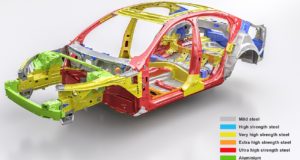
Avalon’s body structure is strengthened to help meet the latest side impact standards, accounting for higher-riding vehicles such as SUVs. In the event of collision, reinforced members, pillars, panels and doors absorb impact energy, then distribute it around and away from the passenger cabin for enhanced impact protection.
Airbags
Avalon’s Dual-stage Front Airbags are designed to deploy with the most appropriate amount of force – lower and less forceful in the event of a moderate collision; higher energy level for more severe impacts. Front Seat-mounted Side Airbags, built into the seat and not the door pillar for enhanced protection, have been designed to provide a greater coverage area. In addition, standard front and rear Side-curtain Airbags help provide protection for all passengers in side impacts. Avalon also features a driver’s knee airbag as standard equipment.
Notice where the side airbag inflator is located?