Skip to content


Hybrid Emergency Responder Training Presentation

No comments

So what do you know about how High Voltage systems work?  Are you scared you will get shocked by a hybrid or EV? Like everything in the fire service, every firefighter should have a basic understanding on a high voltage system works.  Toyota put together a comprehensive hybrid safety training presentation that was developed as a resource to train emergency responders on the safe operation of hybrid vehicles.   The presentation is available for download below. The first link provides the ability to view the presentation, while the second link is a zip file that contains the presentation that can be played from a local system, along with Instructor Notes and a Student Handout.


Hybrid Emergency Responder Training Presentation Extrication

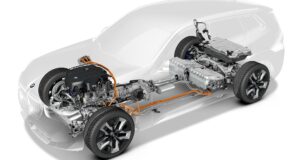
Insulated cables and connectors

All high voltage power cables and connectors are color coded bright orange. The power cables and connectors are insulated to prevent contact with the bare wire conductor.

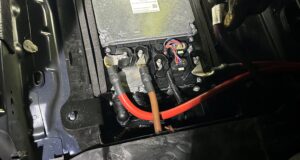
Low voltage wiring connected to vehicle body ground.  The 12 Volt low voltage circuit uses the vehicle metal body as a ground (see picture below illustration). The presentation shows an animation of the low voltage circuit electrical flow through the vehicle metal body ground.  A responder contacting the vehicle metal body ground and a bare positive/hot wire completes the low voltage circuit.

Low 12V Voltage Circuit Rescue Extrication

High voltage wiring insulated from vehicle body ground. The high voltage circuit does not use the vehicle metal body as ground (see picture below illustration). Instead, a separate ground high voltage power cable is routed from the battery to the component. The battery and component are insulated from the vehicle metal body ground.  The presentation shows an animation of the high voltage circuit electrical flow though the high voltage power cables.  A responder contacting the vehicle metal body and a bare high voltage positive/hot wire does not complete the high voltage circuit because the high voltage ground is insulated from the metal vehicle body.

High 12V Voltage Circuit Rescue Extrication

Vehicle Off

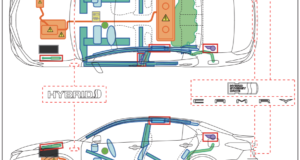
When the ignition switch/power button is Off, no 12 Volt battery power (red dotted lines) is supplied to the hybrid computer which keeps the high voltage battery pack positive and negative relays open (green boxes).  The high voltage circuit is Off, and no electricity flows from the high voltage battery pack to the power cables (orange dotted lines).

High Voltage Extrication Safety Circuit Rescue

Vehicle On

When the ignition switch/power button is turned On, 12 Volt battery power (red solid lines) is supplied to the hybrid computer.  The hybrid computer powers the high voltage battery pack positive and negative relays (green boxes) which allows them to close (orange contacts).  Once the relays close, the high voltage circuit is On and electricity flows from the high voltage battery pack to the power cables (orange solid lines).

High Voltage Extrication Safety Circuit Rescue

Manual protection

To manually disable the high voltage system, turn the ignition switch/power button Off.  This stops electrical flow from the high voltage battery pack to the power cables.

High Voltage Extrication Safety Circuit Rescue

Automatic protection

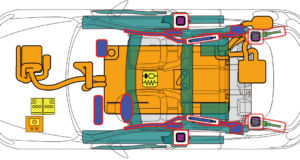
The hybrid computer provides automatic disabling of the high voltage system.  SRS collision sensors (yellow shaded boxes) and high voltage current/voltage sensors (black dashed callouts) are monitored by the hybrid computer.  When airbags deploy or when a current/voltage imbalance is detected, the hybrid computer automatically opens the positive and negative relays to stop electrical flow from the high voltage battery pack to the power cables. A fuse located in the high voltage battery pack also provides automatic high voltage disabling during an overload condition.

High Voltage Extrication Safety Circuit Rescue

Moditech Mondays: 2013 Lexus CT Hybrid

No comments

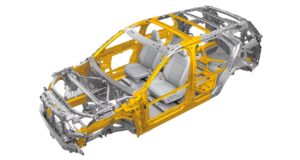
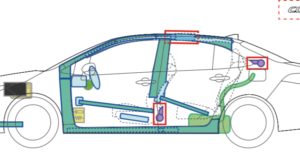
It’s Monday so let’s pull up Crash recovery System by Moditech! Here’s a quick look at the 2013 Lexus CT Hybrid body structure, airbags, and battery locations.

Hybrid Extrication Safety Body Structure

Eight-airbag system including driver’s and front passenger’s advanced airbag system, front seat-mounted side airbags, driver’s and front passenger’s knee airbags and front and rear side curtain airbags.  Pre-tensioners with force limiters for front seats.

2013 Lexus CT Hybrid

First Look: The Hybrid Hook

No comments

Now I’m sure we are never going to look like the guy in the picture on the left.  Lets hope not!  (Sorry Hazmat guys, I’m only an ops guy myself)  However, the picture brings up an interesting question, what’s a quick way to pull a victim away from a shock hazard that is caused by an EV or Hybrid?  An insulated hook? Forget about all the safety systems on these vehicles that automatically disconnect the HV and the view that you would never use a tool like this.  I agree with that 99.9%.  Yet, when we arrive on scene there is no telling what we are going to run into.

So take a look at the Hybrid Hook by Fire Hooks Unlimited.  The Hybrid Hook is made to remove persons grounded to Hybrid battery’s with as much as 600 volts DC. This insulated hook protects at a ratio of 25,000 volts per inch of fiberglass because of it’s unique design.  I sent an email to Fire Hooks Unlimited asking for a little more info so stay tuned.


I have seen Insulated Rescue Hooks like the one below in High Voltage (HV) labs in the auto industry that test HV batteries and cables.

Extrication_Insulated_Rescue_Hook_Safety_Firefighter

2012 Porsche Panamera S Hybrid

No comments

No Emergency Response Guides (ERG) have been released for the 2012 Porsche Panamera S Hybrid. In the mean time, just use the images below to get a brief overview of the HV cables and battery locations.
2012 Porsche Panamera S Hybrid

Quick Look: Porsche Panamera Sport Turismo

No comments

Here is a quick look at a future Porsche, the Panamera Sport Turismo Hybrid.  Porsche is now giving their plug-in hybrids the designation “e-hybrid.”  This concept is a parallel hybrid, which means that the wheels can be driven by the electric motors, the gas engine, or both at the same time. When working together, the car produces 416 horsepower, enough to make it accelerate to 60 in under six seconds.  So look for this one on the road soon.

2013 Annual Extrication Training Events

No comments

Firefighters and rescue personnel should consider attending one of the annual extrication seminars and training events around the United States, Canada, and even around the world that offer different methods of instruction and knowledge.  I believe training outside of your region and comfort zone will further your extrication knowledge and keep you are the leading edge.  In addition, you are able to bring back fresh ideas and tactics to your department.  Below is a list of extrication training seminars and events for 2013.

Make sure you follow our Facebook page!

Southeastern Extrication School

  • Date: February 16, 2013 8:00 AM
  • The 5th Annual Southeastern Extrication School will be held at the Southeastern Institute of Manufacturing and Technology.

KCFTOA Annual PXT 201/202/401 Extrication Academy

  • Date: March 13 – 15, 2013 0800-1700
  • The King County Fire Training Officers Association Present: 2013 Advanced Auto Extrication Featuring the Puyallup Extrication Team and their Unique Teaching Style! Minimal class time with Maximum hands-on training takes you through modern extrication practices using hydraulic and non-hydraulic rescue tools. This 3 day class (PXT 201/202/401)covers vehicle construction, stabilization, disentanglement, and tool knowledge. Scenario based evolutions give the students practical solutions for real world problems. In addition, MGSTECH will give their extremely popular Hybrid and Alternative Fuel vehicles class with up-to-date information to keep first responders abreast of new changes. Lunch is provided. Full PPE is required. Questions regarding the Academy Contact: Lt. Mark Seaver 206.818.2491 mseaver@rentonwa.gov

Heavy Metal Rescue

  • Date: April 5-7, 2013 Corning, NY
  • Last year, T&R Rescue Solutions brought in seven instructors from all over the United States were brought together to help firefighters understand the capabilities of towing and recovery trucks, equipment, techniques and operators as responders in motor vehicle accidents involving trucks, buses, and industrial equipment.

Corona Firefighters’ Auto Extrication Seminar

  • Date: April 12-14, 2013
  • The Corona Firefighters’ Auto Extrication Seminar trains Firefighters in the “art” of removing the vehicle from the patient. Their seminar is often referred to as “the best extrication training in the Western United States”.  For more info, contact Dan Fagan CFA Local 3757 d.fagan@cfa3757.org

Northern Ohio FOOLS Heavy Rescue 101

  • Date: April 19&20, 2013
  • There will be cars, buses, commercial, advanced techniques, newest equipment, Brotherhood, and a great time. Friday evening is typically a classroom session. Saturday is the hands on training part of Heavy Rescue 101.

Crash Course by Howell Rescue Systems

  • Date: May 4&5, 2013
  • Crash Course is a two-day extrication course. It is ONLY held once a year in the spring, and is the undisputed national leader in extrication training.  This course is an intense two-day, all hands-on class involving multiple extrication techniques

Bowling Green State University Heavy Rescue

  • Date: May 6-9, 2013 08:00-17:00
  • The first day of this class will be spent reviewing extrication principles, new vehicle technology, and commercial vehicle/bus familiarization. Days two, three, and four will be held at a commercial vehicle/ heavy equipment facility. You will be challenged to work individually and in teams to respond to increasingly complex rescue scenarios. These scenarios may include; car/truck underride, partially submerged vehicles, commercial truck, school bus, basic rope haul systems, heavy lifting, and torch use. Safety will be stressed at all times

Big Rig Hots

  • Date: June 19-22, 2013 Leduc County, Alberta Canada
  • This learning and hands on training symposium will provide an opportunity for firefighters from all over Canada to witness and participate in extremely complicated large vehicle rescue and extrications. Participants of this symposium will have the opportunity to be involved in four workshops involving complicated stabilization and extrication Techniques that demonstrate: “Cab Extrications”, “Under-Runs”, “Overturns”, and “Dealing with Cement Mixers”.

Crunch Time Extrication Symposium

  • Date: September 27-29 Roscoe,IL

RESCUE DAYS

  • Date: October 4-6, 2013 Geldern, Germany
  • RESCUE DAYS is the worldwide largest training event on technical rescue. WEBER HYDRAULIK initiated a seminar series more than 10 years ago and are continuing it with RESCUE DAYS as an annual highlight.  RESCUE DAYS should be on every firefighter’s bucket list!

So-Cal Auto-X Academy

  • Date: TBA

So-Cal Big Rig Rescue

  • Date: TBA
  • The second annual Southern California Big Rig Rescue Academy will be hosted by the Riverside County Fire Department at the Ben Clark Fire Training Center in Riverside, California. The 3 day So-Cal Big Rig Rescue Academy is packed full of the most current heavy lift and big rig extrication techniques.  The academy curriculum is taught by the industry’s leading instructors and delivered through 80% hands-on instruction.

Southern Region Advanced Auto Extrication Seminar

  • Date: TBA


2013 Ford Fusion Hybrid ERG

No comments

Quick Review.  Below is a quick overview of the 2013 Ford Fusion and Lincoln MKZ Hybrid and Fusion Energi. The emergency response procedures for the Fusion Hybrid, MKZ Hybrid and Fusion Energi vehicles are similar to those for traditional gasoline-powered vehicles with the addition of special considerations for the high-voltage electric system components.

The Fusion Hybrid, MKZ Hybrid and Fusion Energi vehicles use a conventional gasoline
engine in addition to an electric motor to power the vehicle.

  • Gasoline is stored in a traditional fuel tank.
  • Electricity is stored in a high-voltage battery pack.

For additional information review the 2013 Fusion MKZ Hybrid Emergency Response Guide.

2013 Ford Fusion and Lincoln MKZ Hybrid

Extrication Safety EGR Ford 2013 Fusion Hybrid

Component Location/ Description Function
1 High-Voltage Battery Approximately 300-Volts DC
  • Lies flat in the trunk area, located behind the rear seat.
  • Sealed lithium battery.
Provides high-voltage storage for vehicle’s electric motor.
2 12-Volt Battery
  • Located in the trunk area of the vehicle
  • Typical automotive 6-cell lead/acid design.
Provides 12-volts for vehicle accessories.
3 High-Voltage Service Disconnect
  • Located behind the rear seatback
  • Orange rectangle with a molded plastic handle, about 100 mm (4 in) in length.
Provides means to disconnect high-voltage battery for safely servicing vehicle.
4 High-Voltage Wiring
  • Runs along the vehicle’s floorpan from the high-voltage battery to the Electronically Controlled Continuously Variable Transaxle (ECVT), to the DC-to-DC converter and then to the electric A/C and heater units.
  • All high-voltage wiring has orange-colored insulation.
Provides physical connection between high-voltage battery and vehicle’s high-voltage equipment.
5 Transmission Control Module
  • Located above the transmission.
  • Contains controlling electronics for managingpropulsion.
Provides rotational force during Electrical Drive Modes. Generates 3-phase AC high-voltage electricity via two cables to and from the traction motor and generator.
6 Electronically Controlled Continuously Variable Transaxle (ECVT)
  • Transverse-mounted design,
    similar to the non-Hybrid
    Fusion MKZ vehicles
Provides rotational force to the wheels for vehicle propulsion and transmits rotational force to the engine’s generator to recharge batteries.
7 Electric A/C Compressor
  • Located in front of the engine.
  • It has an orange high-voltage wire attached to it using an interlock connector.
Provides electric A/C operation; replaces the belt driven A/C compressor.

2013 Ford Fusion Energi

Extrication Safety EGR Ford 2013 Fusion Energi

Component Location/ Description Function
1 High-Voltage Service Disconnect
  • Located behind the rear seat back.
  • Orange rectangle with a molded plastic handle, about 100 mm (4 in) in length.
Provides means to high-voltage battery for safely servicing vehicle.
2 High-Voltage Battery Approximately 300 Volts DC
  • Lies flat in the trunk area,located behind the rear seat.
  • Sealed lithium battery.
Provides high-voltage storage for vehicle’s electric motor.
3 110-Volt Cordset
  • Located in the trunk area ofthe vehicle.
Provides 110v charging option to the high-voltage battery when connected to the charging port .
4 12-Volt Battery
  • Located in the trunk area of the vehicle.
  • Typical automotive 6-cell lead/acid design.
Provides 12-volts for vehicle accessories.
5 High-Voltage Wiring
  • Runs along the vehicle’s floorpan from the high-voltage battery to the Electronically Controlled Continuously
    Variable Transaxle (ECVT), to the DC-to-DC converter and then to the electric A/C and heater units.
  • All high-voltage wiring has orange-colored insulation.
Provides physical connection between High-Voltage battery and vehicle’s High-Voltage equipment.
6 Charging Port
  • Located on the driver side fender.
Provides 110v charging option to the high-voltage battery when the vehicle is not in operation .
7 Transmission Control Module
  • Located above the transmission.
  • Contains controlling electronics for managing propulsion.
Provides rotational force during Electrical Drive Modes. Generates 3-phase AC High Voltage electricity via two cables to and
from the traction motor and
generator.
8 Electronically Controlled Continuously Variable Transaxle (ECVT)
  • Transverse-mounted design, similar to the non-Hybrid Fusion MKZ vehicles.
Provides rotational force to the wheels for vehicle propulsion and transmits rotational force to the engine’s generator to recharge batteries.
9 Electric A/C Compressor
  • Located in front of the engine.
  • It has an orange high voltage wire attached to it using an interlock connector.
Provides electric A/C operation; replaces the belt driven A/C compressor.
10 Electric Heater
  • Located in the engine compartment on the passenger side.
Provides passenger compartment with heat without the need to turn the engine on.

Hidden Hazards Inside of a Vehicle

No comments

The automotive industry has changed the way first responders approach a motor vehicle accident compared to a decade ago.  Air bags are standard equipment, pretensioners are used in second and third row seats, and the seats are starting to resemble a firefighter jet seat with the technology packed into a small package.  Situational Awareness is the new catch phrase in the extrication world.  First responders must be aware of hazards of a vehicle from bumper to bumper!

For years extrication trainers preached peel away the plastic interior trim to ensure an air bag gas inflator is not in the cut path.  However, those days are long gone!   What we need to start doing is a quick “trauma assessment” if you will on our vehicles before we make a cut to any pillar or roof structure.  Once the interior trim is pulled off palpate any visible nylon air bag curtains close to the metal.   Deployed gas inflators statistically do not pose a safety hazard if cut.  However, the best stance to take is to never cut through a gas inflator because there is no method available to us to determine if the inflator is still charged.

Occupant sensors in the front seats are devices that measure the distance away from the steering wheel or dash and weigh the occupant to determine if the air bag should be deployed in a crash.  Have you ever put your backpack on the passenger seat and notice that the “Air bag Off” light turns on?  This is an example of the sensor weighing the load on the seat and determining that the occupant in the seat does not meet the minimum weight for the air bag to deploy in a crash.

Pretensioners

Seatbelt pretensioners tighten the belt a few inches to prevent the occupant from jerking forward in a crash.  Pretensioners are mounted in two different methods, to the seat belt retractor located in a body pillar or on the seat structure.  Front seat mounted pretensioners are typically mounted to the top of the seat adjustment track.  Seat mounted pretensioners will moved the seatbelt buckle and not the seatbelt. A center console usually provides enough protection for first responders not to have to worry about any hazards from charged pretensioners.

Buckle mounted pretensioners uses gas stored in the tube to retract the buckle during certain crashes. Retractor mounted pretensioners like the TRW one in is set off by any electronically fired pyrotechnic charge which retracts the seatbelt by 80mm, which is more than three inches.  During the earlier stages of a crash, the pretensioner removes excess slack in the seatbelt to begin effective occupant restraint.

 Pretensioners Extrication Safety Firefighter

Pretensioners are not reserved for front seat passengers.  Many late vehicles like the Volvo have pretensioners in the rear seats. Pyrotechnic pretensioners in the rear seats can be buckle or retractor mounted.  Many rear seats that are split into 60/40 seats have a metal tower that is thick and big that holds a high mounted seat belt retractor. This tower is located in the 60% seat or the larger of the two.  If the seats are split up into 40/20/40 than the tower is located in the center or 20% seat.

Some vehicles have a pre-collision safety system that includes an electric motor-pyrotechnic pretensioner system.  During a pre-collision event like extreme sudden hard braking, an electric motor in the pretensioners retracts the front seatbelts.  Once the event stabilizes the electric motor will reverse itself.  The pyrotechnic pretensioners function normally and separately from a motor-pyrotechnic pretensioner system.

Load limiting is a safety that is used to minimize belt-inflicted injuries. A basic load limiting feature is sewn into the belt webbing and stitches are designed to break when a certain load is applied to the belt. The belt extends when the stitches come apart and allow the sewn webbing to unfold.   A mechanical load limiting device use

Air bags

Air bags entered the automotive market as an air bag in the driver’s steering wheel.  In 2011 model year vehicles, 10 different air bags in per vehicle are no longer a feature reserved for expense luxury vehicles.  Automakers proudly advertise air bags on the vehicle interior on the steering wheel, bash panel, and pillar trim panels.

Seat Air bags

Seat mounted air bags are not a new hazard facing first responders.  The difference is in the size and numbers of air bags packaged in a Seat Airbag ID Extricationseat are changing.  Front seats can have two separate air bags to protect the occupant during a crash.  This number is expected to increase when centered mounted seat air bags are used.  Seat air bag are located along the outside of seat back frame and the bag is stored in a deflector called a “Taco” that directs the air bag when deployed.

Center Mounted Seat Air bag

Center Seat Airbag Safety ExtricationGeneral Motors has developed a  front center air bag deploys from the right side of the driver’s seat and positions itself between the front row seats near the center of the vehicle.   The tubular tethered air bag is designed to act as an energy absorbing cushion between driver and front passenger in side crashes. The air bag will also be deployed during a rollover.  The center mounted seat air bag will be in the Buick Enclave, GMC Acadia, and Chevrolet Traverse starting in the 2013 model year. Toyota developed a rear center console with an air bag that deploys between the rear passenger seats.  Toyota has not put this air bag into production yet, but it is likely to make into a vehicle platform soon.

Side Air bags

Occupant ejection mitigation is new safety requirement that the automakers must meet by 2017.  Side air bags and glazing of side window glass are the methods being tested and engineered into current model vehicles.  These air bags will be large volume that can run from A-pillar to D-pillar.  The 2011 Grand Caravan has a side impact air bag over nine feet long and is inflated by a stored gas inflator the size of a child’s lunchbox thermos and has over 10,000psi!  

Side Airbag Extrication

2011 Dodge Caravan Side Air bag

Knee Air bags

Knee air bags are typically located underneath the steering wheel on the angled portion of the instrument panel.  The knee air bag module is a rectangle box easily package as a complete air bag systems with the gas inflator inside.  This helps during installation at the auto plants and allows this system to be used in different vehicles.

Door Air bags

Many luxury auto makers have started installing door air bags.  The air bags are typically installed in the center of the door.

Airbelts

 Airbelt Seat belt airbag extrication safetyThe 2011 Ford Explorer was the first production vehicle to have inflatable rear seat belts.  Ford plans to offer inflatable seat belt technology in vehicles globally in the future. What is important to remember is the airbelt requires a stored gas inflator store in the seat.  A pioneering company, Moditech, provides current information on hazards inside and outside the vehicle.  Moditech developed the Crash Recovery System (CRS) and the image below of the 2011 Ford Explorer.


 2012 Ford Explorer Rear Seat Belt Airbag extrication CRS Moditech

Key Fobs

Ready On Key Fob ExtricationKeyless ignition is nothing new but many automakers are offering the features on their vehicles.  Hyundai offers keyless ignition with a key fob or smart key that works on proximity.   So how do you turn the car off if there is no key in the ignition?  Most vehicles have a “Start” or “Power” button that is used to switch the ignition from off, to on, or to ACC.  Make sure you the button indicator light is off.  If you see a “READY-ON” light on the display the vehicle is started.  This is very important with hybrid or electric vehicles because of the quiet operation.  An important note, on some vehicles the “Power” button indicator light turns off when the vehicle is started.  That is why it is important to make sure you do not see “READY-ON”!

Batteries

First responders are aware of hybrid and plug-in electric batteries inside of the passenger compartment.  However, 12-volt batteries can also be found inside of the passenger compartment.  For example, the GMC Acadia has the 12-volt battery located in the floor behind the front passenger seat.

 Extrication Battery Location Floor

Is that vehicle totaled?

Late model vehicles have dozens of safety systems that keep occupants safe during a crash or rollover.  Just because the vehicle may look repairable does not necessarily mean it is.  Plastic interior trim panels and seat covers are designed to rip or tear when air bags deploys.   Seat structures are engineered to distribute the load of an occupant.   Seatbelts can have rip stitching to absorb energy from the occupant.  Pyrotechnic pretensioners are onetime use.  Keep in mind that most of the time in a serious accident the glass is already broken out and the windshield typically has spider marks from the air bags or occupants.  Never let the fear of “totaling” a vehicle compromise patient care.  Just remember all the hazards mentioned in this article are real and in vehicles.

Firehouse Expo 2012 Extrication Speaker handouts

No comments

The handouts for a good number of the Fire house Expo 2012 were posted online for everyone to benefit from.  Check out Ron Moore and Billy Leach’s handouts!

Hopefully,  I’ll get a chance to present at Firehouse Expo 2013.  I have a few great ideas for classes!

Hands-On Training: Heavy Rescue For Heavy Vehicles (HT4 OR HW4):

The Challenges of Extrication Involving Vehicles With Advanced Steel:

Heavy Truck Anatomy and Extrication:

Hybrid & Electric Plug-In Vehicle Fire & Rescue Procedures:

Bergen Toll Plaza Hybrid Car Fire

1 comment

Looking at the pictures, what is the first thing that comes to your mind? I hope one quick thought will make a light go one!

New Jersey highway officials say two cars were involved in an accident at a Garden State Parkway toll plaza that resulted in a car hitting a toll booth and bursting into flames.  State Police Sgt. Brian Polite says a Toyota Prius driven by 86-year-old Ralph Schiller of Fort Lee was approaching the Bergen Toll Plaza in Saddle Brook around 3:30 p.m., when it side-swiped a Honda Accord driven by Kristie Frost of Pasadena, Md. Police say Schiller’s car continued forward and struck a barrier and a toll booth, and the booth and car both caught fire.

Below are a few key instructions from the Toyota Prius Hybrid Emergency Response Guide:

Offensive Fire Attack

Normally, flooding an NiMH HV battery pack with copious amounts of water at a safe distance will effectively control the HV battery pack fire by cooling the adjacent NiMH battery modules to a point below their ignition temperature. The remaining modules on fire, if not extinguished by the water, will burn themselves out. However, flooding the PRIUS c HV battery pack is not recommended due to the battery case design and location preventing the responder from properly applying water through the available vent openings safely. Therefore, it is recommended that the incident commander allow the PRIUS c HV battery pack to burn itself out.

Defensive Fire Attack

If the decision has been made to fight the fire using a defensive attack, the fire attack crew should pull back a safe distance and allow the NiMH battery modules to burn them selves out. During this defensive operation, fire crews may utilize a water stream or fog pattern to protect exposures or to control the path of smoke.

When allowed to burn themselves out, the PRIUS c NiMH battery modules burn rapidly and can quickly be reduced to ashes except for the metal.

Nearly every Emergency Response Guide that the automakers published is available for download on our Emergency Response Guides/ page.

Variable Torque Motors (VTM) Hybrid System

No comments

Did you ever think you would encounter the Flux Capacitor from the movie Back to the Future at an MVA?  Do you need to look out for 1.21 gigawatts?  Believe it or not, the Flux Capacitor was an ultra-capacitor.  Though the Variable Torque Motors (VTM) ultracapacitors aren’t made to hold the massive 1.21 gigawatts of the DeLorean in the movie.

The VTM Hybrid is designed for all types of Class 3 though 7 vehicles including shuttle buses, refuse trucks, delivery vans and school buses. The VTM Hybrid is the most affordable hybrid solution on the market. How the system works is it automatically adds torque ahead of the engine to boost acceleration and then conserving energy normally lost in the braking process. What is very interesting is the system is 500 pounds lighter than alternative hybrid systems because instead of batteries it uses ultracapacitors to store energy. Yes good old ultracapacitors!

Ultracapacitors Hybrid Extrication VTM

Ultra-Capacitor_hybrid_Extrication_ultracapacitor

Variable Torque Motors ERG

Emergency shutoff switches are clearly marked and easily located (including one at the driver’s side) in case of an accident or for maintenance safety.  These switches isolate the ultra-capacitors to ensure that no power can be discharged to the vehicle and simultaneously inform emergency responders that the vehicle is a hybrid, which can change their response tactics.

Variable Torque Motors

2013 Ford Hybrid and Electric Vehicles HV Batteries and Disconnects

No comments

The 2013 Ford Towing Guide is available online and has some good information that we can use while we await the release of the 2013 Emergency Response Guide (ERG).

2013-ford-focus-electric-badgeFocus Electric Battery and High Voltage Service Disconnect Locations

  1. High Voltage Batteries
  2. High Voltage Service Disconnects
Focus Electric Battery and High Voltage Service Disconnect Locations

Ford-Fusion-Hybrid-2013 BadgeFusion Hybrid Battery and High Voltage Service Disconnect Locations

  1. High Voltage Service Disconnect
  2. High Voltage Battery

Fusion Hybrid Battery and High Voltage Service Disconnect Locations

2013-ford-c-max-energi-door-badgeC-Max Hybrid Battery and High Voltage Service Disconnect Locations

  1. High Voltage Battery
  2. High Voltage Service Disconnect

C-Max Hybrid Battery and High Voltage Service Disconnect Locations


Extrication Update

No comments

During my classroom portion of the train the trainer class in Ann Arbor, I talked about how useful the Internet and even Facebook is to the fire service, especially the extrication discipline!   Take a look at the links below for some great extrication information!

  • First Due Tackle by Paul Hasenmeier (Paul will be a great addition to the FireEMSBlogs.com network,  make sure you like the First Due Tackle Facebook page)
  • Rediscovering the Air Chisel by Les Baker (Why so many firefighters don’t use this tool—and what they should know about its many practical uses)
  • Interior Ramming vs. Exterior Spreading by Les Baker (What the interior rescuer needs to know to conduct aggressive clearance tactics to displace the roof)
  • Game Plan Your Extrications by Desmond Fulton (The IS-SAVED acronym offers an easy-to-remember plan for the extrication scene)
  • Episode 274: X-Trication Radio by David Dalrymple (David Dalrymple hosts X-Trication Radio once a month on Fire Engineering’s Blog Talk Radio channel. Make sure you listen when you have the chance. All the previous episodes are available on Fire Engineering’s channel. You can even stream past episodes thru your car radio. I caught up on a couple of episodes I missed during my drive to FDIC. There’s no place that you cannot turn into a training place!)
  • Moditech CRS screenshot on Facebook (Moditech posts a Crash Recovery System (CRS) screenshot and asks their Facebook page followers what they notice about the vehicle and the hazards, etc on the vehicle. )CRS Moditech Extrication Facebook

2013 Toyota Yaris Hybrid

No comments

First look at the 2013 Toyota Yaris Hybrid.

2013 Mercedes-Benz SLS AMG E-Cell Supercar

No comments

Mercedes-Benz  has a 526 horsepower electric drivetrain in the upcoming SLS AMG E-Cell supercar. Power for the E-Cell will be provided by four electric motors. The E-Cell employs a permanent all-wheel drive system which is powered by a 400-volt battery made up of 12 modules of 72 lithium-ion polymer cells.  The battery is housed in within the carbon fiber transmission tunnel, which is structurally integrated into the E-Cell’s aluminum body shell.  This is a 2013 model year vehicle expected to hit the roads in the fall of 2012.

NFPA Commends MA for New Electric Vehicle License Plates

1 comment

Emergency responders in Massachusetts will now have another way to easily identify electric and hybrid vehicles. Massachusetts has become the second state to unveil a new license plate for hybrids and electric vehicles, a move that aligns with the goals with the National Fire Protection Association’s (NFPA) Electric Vehicle Safety Project.

Read the complete story at FireEngineering.com

Also check out the NFPA‘s website and learn more about NFPA’s electric vehicle training series.

2012 Honda CR-Z Hybrid Body Structure

No comments

Here’s a quick look at the 2012 Honda CR-Z Hybrid body structure and interior hazards.

2012 Honda CR-Z Hybrid Body Structure Extrication

2012 Honda CR-Z Hybrid Body Structure

2013 Volkswagen Jetta Hybrid

No comments

First off, if you haven’t liked the Boron Extrication page on Facebook, please do!

2013 Volkswagen Jetta Hybrid Body Structure Extrication BIWThe 2013 Volkswagen Jetta Hybrid is set to hit the US market during the second half of 2012.  The hybrid has a State-of-the-art battery: A lithium-ion battery supplies the energy to the electric motor. The compact 220-volt, 1.1 kWh battery is integrated behind the rear bench seat and weighs less than 80 lb. The battery consists of 60 individual cells with a combined energy capacity of 5 Ah. The frequency of the discharge and charge cycles in hybrid operation requires high- performance battery cooling, which is handled by a fan mounted directly on the device. The battery also has its own management system that performs safety, diagnostic, and monitoring functions as well as temperature management. The battery is disconnected when it‟s not in use or if the car is involved in a collision.

Standard safety equipment for all Jetta models includes Electronic Stability Control (ESC), anti- lock brakes (ABS), and six airbags (driver and front passenger airbags, front side thorax airbags and Side Curtain Protection® airbags front and rear).

2013-Volkswagen-Jetta-Hybrid.

2013-Volkswagen-Jetta-Hybrid

2013 Volkswagen Jetta Hybrid Battery

2013 Volkswagen Jetta Hybrid Battery

2012 Buick LaCrosse eAssist Hybrid

No comments

Just like the 2012 Buick LaCrosse, the 2013  Chevrolet Malibu Eco shares the same hybrid style system.

2012 Buick LaCrosse with e-Assist Technology Hybrid Extrication

Buick Emergency Response Guides:

2012 Buick LaCrosse with e-Assist Technology Hybrid Extrication

What’s under the Hood in 2013?

No comments

So what’s under the hood?  The engine right?  Yes and a little more.  The high voltage battery pack on the 2013 Mercedes Benz E400 Hybrid is the battery is behind the front strut tower.  In the pictures below, one shows the battery cover and with the battery covered removed. The high voltage orange cables are very close to the right fender.  Keep this in mind if you are making an relief cuts for a modified dash lift. The 0.8Kw Li-Ion battery pack operates at 120Vdc.

2013 Mercedes-Benz E400 Hybrid High Voltage Battery

2013 Mercedes-Benz E400 Hybrid High Voltage Battery Cover

2013 Mercedes-Benz E400 Hybrid High Voltage Battery

2013 Mercedes-Benz E400 Hybrid High Voltage Battery

2013 Chevrolet Malibu Eco; AKA a Hybrid, kind of!

4 comments

The Chevrolet Malibu Eco vehicles are front-wheel drive, five passenger vehicles with a lightly electrified gasoline engine. The eAssist system utilizes a high voltage battery, located in the trunk, as a supplemental power source. The system assists the engine utilizing a high torque belt-driven starter / generator.

2013 Malibu Eco Chevrolet eAssisst Extrication Hybrid Battery HV Cable

The eAssist system features a 130 volt lithium-ion battery, which provides electrical energy to the starter / generator. The high voltage battery assembly is located in the trunk behind the rear passenger seats. The assembly includes several internal components that operate together to provide and control the high voltage for the eAssist system.

 2013 Malibu Eco Chevrolet eAssisst Extrication Hybrid Battery HV Cable

There are two separate electrical systems within the eAssist vehicles: low voltage (12 V) and high voltage (130 V). The low voltage system is similar to a conventional vehicle.

Do NOT cut the:

  • Roof rails near the center pillar; contains side curtain airbag inflators
  • Front seat back on the outboard edge; contains side airbags
  • Center pillar near the rocker; contains the seat belt retractor pretensioner and side impact sensor

2013 Malibu Eco Chevrolet eAssisst Extrication Hybrid Battery HV Cable Body Structure

The Chevrolet Malibu Eco is designed to protect the occupants during a collision. The body structure contains high strength steel; this is highlighted in blue. The occupants are protected from front, rear, and side impacts by a structural cage created by the underlying vehicle structural design.  Additional crumple zones protect the occupant with front, side, and rear rails that are designed to crush in a crash.

2013 Malibu Eco Chevrolet eAssisst Extrication Hybrid Battery HV Cable Body Structure

Cut through the low voltage cables on each side of the yellow labels to remove a section of the cable to ensure the cables cannot inadvertently reconnect.

Make sure you read thru the Emergency Response Guides below:

Extrication Train the Trainer in the Detroit Area

No comments

If you are looking for a train the trainer extrication course in the Detroit area, look no further!  Brock Archer, Ron Moore (from Firehouse Magazine and the University of Extrication) and myself are teaching a 5 day extrication course.  The classroom portion will be at the Ann Arbor Fire Department and the hands on training will be by Detroit Metro Airport.  Brock will be bringing his West Coast extrication knowledge to the Motor City! Ron Moore will also be presenting, I have stated this before, every firefighter needs to see Ron present in person!  This will be a course that everyone will be talking about!

Check out the flyer below and the course outline and contact me with any questions.

Extrication FDIC Train the Trainer Ron Moore Brock Archer Detroit

National Alternative Fuels Training Consortium Training App

No comments

John Shafer over at the GreenMaltese.com posted about the National Alternative Fuels Training Consortium (NAFTC) offers first responder safety training.  This training equips first responders with the knowledge they need to confront a growing number of automotive accidents involving AFVs.

The National Alternative Fuels Training Consortium’s First Responder Safety Training features a suite of modern technology products and training for electric drive vehicles. Participants learn important information needed to safely respond to accidents involving these vehicles. These topics include key vehicle and fuel properties and characteristics, vehicle components, vehicle identification and recommended first responder procedures. The suite of products includes:

  • Instructor manuals
  • Participant manuals
  • Workshop booklets
  • Quick reference guide
  • Mobile device app
  • Online training (for Electric Drive only)>/li>

 This first responder quick reference guide, developed by the National Alternative Fuels Training Consortium (NAFTC), is a tool for emergency personnel who need to access information about alternative fuel and advanced technology vehicles at an accident scene. This app contains information on advanced technology vehicles such as hybrid, plug-in hybrid, battery, and fuel cell electric vehicles, as well as vehicles powered by alternative fuels such as biodiesel, ethanol, natural gas, propane, and hydrogen. You will find detailed, vehicle-specific information including identification mechanisms, disconnect procedures, and other special concerns. Although similar, each vehicle has distinct differences that make it unique, and first responders need to know and understand these differences. The NAFTC understands the hazards that alternative fuel and advanced technology vehicles could pose to emergency personnel, and this app, along with our entire suite of First Responder Safety Training products, provides first responders with the information needed to safely respond to an accident involving one of these vehicles. This app can be used on both the iPhone and the iPad.


Mitsubishi i-MiEV (Mitsubishi innovative Electric Vehicle)

No comments

MiEV is an acronym for Mitsubishi innovative Electric Vehicle and it is a five-door hatchback electric car and is the electric version of the Mitsubishi i.   There is not an Emergency Response Guide (ERG) for the North America version yet because the 2012 model is the first year sold in the United States.  The information below is taken from the European market, well the Germany ERG for the 2011 Mitsubishi MiEV.  The US version will have some changes, but expect most of the vehicle to remain unchanged.  Check back, I’ll post info on the 2012 US model as soon as it is available.

More Mitsubishi rescue data sheet/rescue maps are located here.

2012 Mitubishi-erg Extrication Battery Hazards CRS

2012 Mitubishi-erg Extrication Battery Hazards CRS


Ford Focus Electric

No comments


The Focus Electric is powered by a 23 kwh high-voltage, lightweight lithium-ion battery system. It uses an advanced active liquid cooling and heating process to regulate battery temperature and help maximize battery life, so you can get the most miles out of each charge.Ford Focus Electric Hybrid Extrication Battery Plug-in